
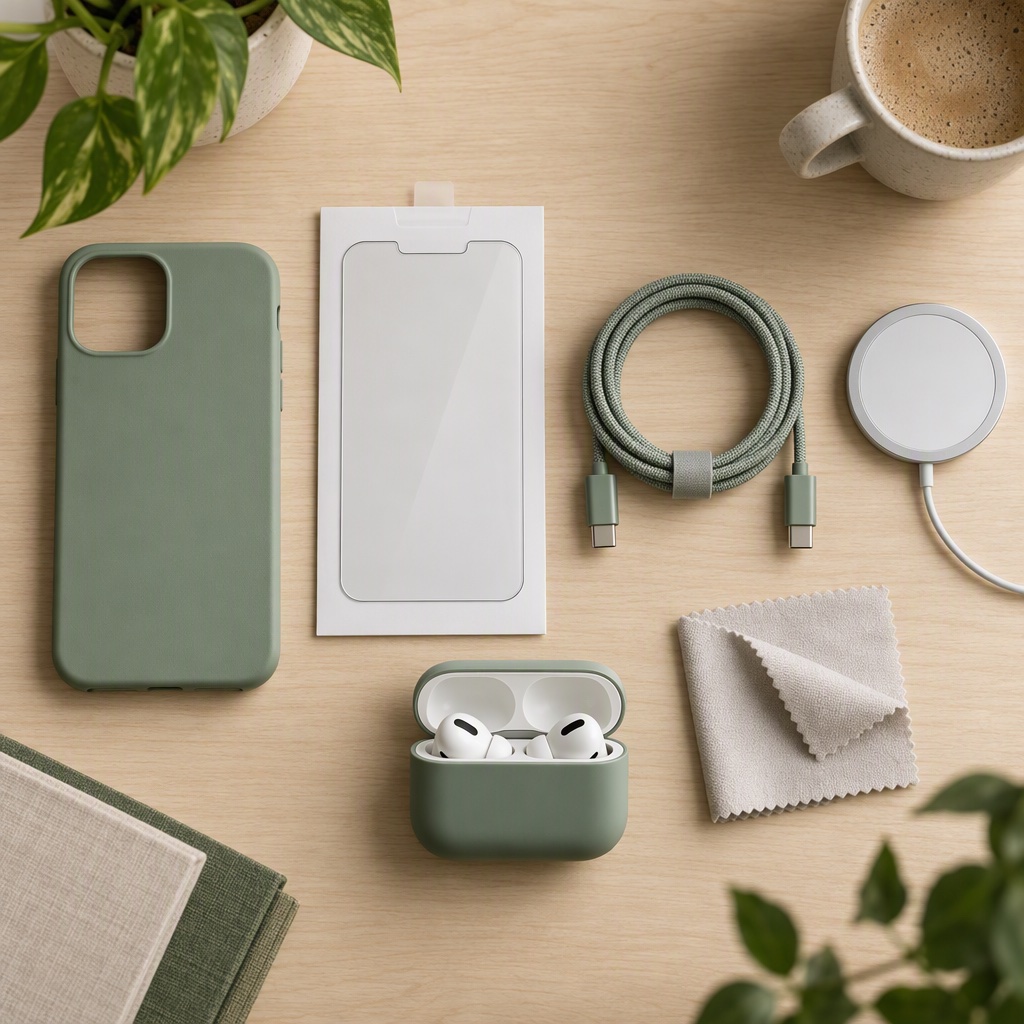
A student’s phone does three jobs at once: it is a schedule, a study tool, and the thing that gets them home safely. Building a small kit around those jobs costs far less than most people expect, and it prevents the two failures that ruin a campus day, a dead battery and a cracked screen. Here is what is genuinely worth carrying and what can wait.
- A compact power bank and a short cable cover most of a long campus day.
- A screen protector and a slim case are the cheapest insurance against a cracked screen.
- Wired earbuds or a small stand help in libraries, lectures, and study rooms.
- Skip anything bulky, because a good bag kit should fit in one small pouch.
What belongs in a basic student phone kit?
Start with protection, then power, then comfort. Protection means a case that absorbs a drop and a screen protector that takes the scratches instead of the glass, because phones get dropped on stairs, in crowds, and on the way to class. Power means a compact power bank and a short cable, which together cover the gap between a long day and a single wall outlet. Comfort means earbuds for lectures and a way to prop the phone up for video. Add a microfiber cloth for a smudged screen and a small pouch to keep the cables from tangling. That is the whole kit, and everything in it earns its place. Anything that does not fit in the pouch will get left behind.
How big a power bank do students need?
Big enough to refill the phone once, and small enough to actually carry. A power bank only helps if it is in the bag when you need it, and the ones that stay at home are always the heavy ones. For most students, a slim model that fits in a jacket pocket is the right answer, with a second larger one kept in the dorm or apartment for trips and long study sessions. Check two things before buying: that it has enough capacity to charge your phone at least once, and that it can deliver enough power to charge at a reasonable speed rather than trickling. If the choice between size and capacity feels difficult, our guide on choosing a power bank walks through it.
Why does a screen protector matter more on campus?
A cracked screen is the single most expensive thing that happens to a student phone, and campus life is full of the conditions that cause it: stairs, crowded hallways, shared tables, bags stuffed with books, and phones set down on rough surfaces. A screen protector is inexpensive, and it takes the daily abuse so the glass underneath does not. Tempered glass is the usual choice because it feels like the original screen and is easy to replace, while film is thinner and more discreet but scratches sooner. Either way, the point is that a scuffed protector is a small annoyance and a cracked screen is a serious cost. A protector plus a case with a raised lip is the combination that prevents most damage.
What helps in lectures and libraries?
Two things dominate: sound and angle. For sound, wired earbuds are the practical choice for students because they never need charging, never run out mid-lecture, and do not get lost as easily as separate earbuds. A short cable keeps the wire out of the way. For angle, a small folding stand or a grip turns the phone into something you can actually watch while taking notes, and it stops the phone from lying flat and reflecting every overhead light. In a shared study room, a stand also keeps the phone out of the way rather than sliding around the table. Add a screen protector with a matte finish if overhead lighting is a problem. A tidy setup like this also fits the approach in our guide to desk accessories that cut clutter.

Cables & Adapters — cable. Designed for everyday carry and backed by our 30-day happiness guarantee.
What should students not bother buying?
Plenty of accessories promise more than they deliver in a student’s actual day. Extra-long cables seem useful until they tangle in a bag, and a second charger that never leaves the dorm is just a charger you already own. Novelty cases with moving parts break quickly, and thick wallet cases can be more annoying than handy if you already carry a card holder. Very large power banks are tempting on capacity alone, but they are heavy enough that people stop carrying them. Skip anything that needs its own charging routine unless it clearly saves you time. The test is simple: if you cannot explain when you used it in the last week, it does not belong in the bag.
How do you keep the kit organized and cheap?
Organization is what keeps a small kit usable. A single zippered pouch with the power bank, the cable, the earbuds, and the cloth prevents the classic problem of a bag full of loose cables. Keep a short cable for the bag and a long one at home, so you are never undoing a tidy setup to reach an outlet. Replace things as they fail rather than all at once, and buy one good item instead of three cheap ones that wear out. Check that any cable matches your phone’s connector, since the wrong cable is the most common wasted purchase. Finally, keep the pouch somewhere consistent, because a kit you cannot find is no better than one you never bought.
Frequently asked questions
- What is the most important accessory for a student phone? A screen protector, followed closely by a protective case. Together they prevent the most common and most expensive damage. Everything else is about convenience rather than protecting the phone itself.
- Do students really need a power bank? If you spend long days on campus with heavy phone use, yes. A slim one that fits in a pocket covers the gap between classes and a wall outlet, and it is far cheaper than being stranded with a dead phone.
- Are wired earbuds better than wireless for students? For lectures and study sessions, wired earbuds have real advantages: no charging, no pairing, and less to lose. Wireless is more convenient for commuting, so the best answer depends on how you use them.
- How much should a student spend on a starter kit? You can cover the essentials for well under what a phone repair costs. Prioritize a case, a protector, and a compact power bank, then add earbuds and a stand when the budget allows.
- What cable should students carry? One short cable that matches your phone’s charging connector, plus a wall plug. A single good cable that stays in the bag beats a tangle of spares, and it is easier to replace when it finally wears out. If you can, buy a second one and keep it at home as a spare, so a failed cable never leaves you without a charge.


