
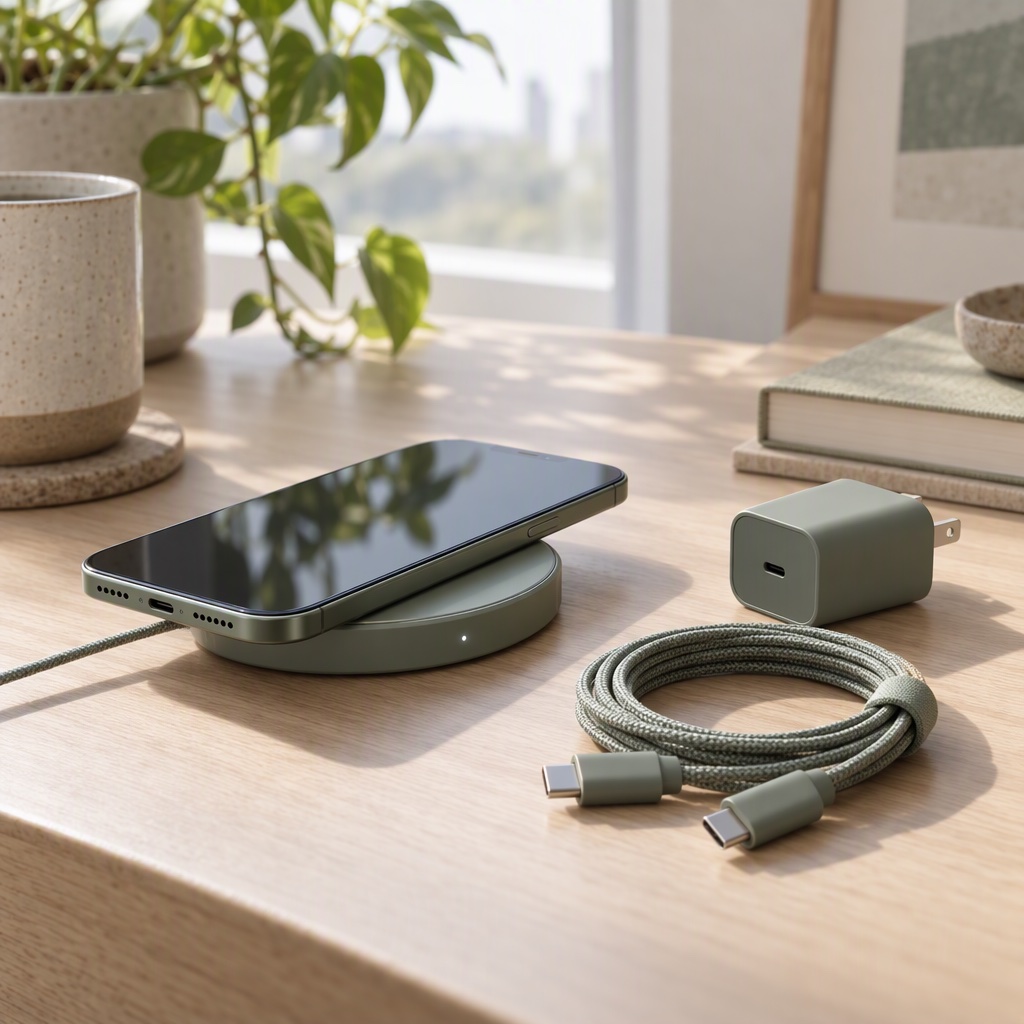
A power bank is only worth carrying if it matches how you actually use your phone. The right one holds enough charge for the days you are away from an outlet, fits the pocket or bag you carry it in, and tops up your phone at a speed you are willing to wait for. Everything else — extra ports, digital readouts, wireless pads — is a bonus you can weigh once the basics line up.
- Match capacity to your real days away from an outlet, not to the biggest number on the shelf.
- Check the output wattage your phone accepts before paying extra for speed you cannot use.
- Pick a size and weight you will genuinely carry every single day.
- Look for at least one USB-C port and a clear charge indicator.
How much capacity do you actually need?
Capacity is measured in milliamp-hours, or mAh, and it describes how much energy the battery inside can store. A phone battery usually sits somewhere between 3,000 and 5,000 mAh, but no power bank passes on every bit of its rated capacity — a little is lost as heat while charging. In practice, a small bank is a single top-up for most phones, a mid-size one covers a long day or two, and a large one suits weekends away or heavy camera use. Choose the smallest size that covers your worst normal day rather than the largest you can afford. A bank you leave at home because it is too heavy charges nothing at all. If you are unsure, note how often your phone reaches a low charge before you get home, and let that pattern guide you.
What output power should you look for?
Output power, measured in watts, decides how quickly your phone refills. Many phones accept somewhere between 18W and 30W over a cable, and some now take more. A bank that outputs less than your phone can accept will charge it slowly; one that outputs far more will simply be capped by the phone, so the extra headroom is safe but unused. Look for at least 20W on the main USB-C port if you want a meaningful top-up in half an hour. Wattage matters more than capacity for a quick rescue charge, which is why a small bank with a strong output often beats a heavy one with a weak output. Understanding what actually changes charging speed helps you read those numbers without overpaying for them. The cable matters here as well, because a thin charging cable can hold back an otherwise powerful bank.
How many ports do you need?
One port is enough if you only ever charge a phone. Two ports let you top up a phone and a pair of earbuds, or share with someone else, without unplugging anything. Three starts to make sense for travel, when a phone, a watch and a tablet might all need attention on the same evening. Keep in mind that when several devices share a bank at once, the available power is divided between them, so everything charges more slowly. If you often charge two things together, check that the bank can deliver a decent output on both ports at the same time. For most people, a single strong port is more useful than several weak ones. Think about the devices you already carry, and how often they run flat on the same day.
Should you choose a wired or wireless power bank?
Wireless power banks let you set a phone down and charge without a cable, which is genuinely convenient on a train or at a desk. The trade-off is speed and efficiency: wireless charging is slower than a cable and loses more energy as heat, so the same capacity gives you fewer full charges. Wireless banks are also usually thicker, because they contain a charging coil. A good compromise is a bank that does both — wireless for convenience when you are stationary, and a cable for the fastest top-up when you are in a hurry. If you rarely have a flat surface to rest the phone on, a wired bank will serve you better and usually cost less. Treat wireless as a convenience feature rather than your main way to charge.
How big and heavy should a power bank be?
Size follows capacity closely, so the honest question is where you will carry it. A slim bank slips into a jacket pocket and weighs about as much as a phone. A mid-size model is comfortable in a bag but noticeable in a pocket. Anything above that belongs in a backpack or a carry-on. Think about the moment you will actually reach for it: if it is a commute or a night out, smaller wins; if it is a flight or a festival, capacity wins. Weight also matters over time, because a heavy bank in a pocket pulls at your clothes and tends to get left behind. Weigh your own habits honestly before you choose a size. A bank that lives in your bag can be larger than one that lives in your pocket.
What else is worth checking before you buy?
A few small details separate a bank you keep from one you replace. Look for a clear charge indicator, whether that is four small lights or a percentage readout, so you are never guessing. Check that the ports are USB-C rather than older connectors, and that the bank itself can be recharged quickly, since a big battery that takes all night to refill is frustrating. Pass-through charging, which lets the bank and your phone charge from one wall socket, is handy for travel. If you are still unsure whether to pay for speed at all, our guide to whether you really need a fast charger walks through the trade-offs. Confirm the return window before you commit, too, because a bank you can test properly is worth more than one you cannot. Clear markings on the ports make a bank easier to live with, too.
Frequently asked questions
- Can I take a power bank on a plane? Usually yes, in carry-on baggage rather than checked luggage, and larger capacities face limits. Check your airline’s current rules before you fly, since they change from time to time and vary between carriers.
- Does a bigger power bank charge my phone faster? Not by itself. Speed comes from output wattage, not capacity, so a small bank with a high output can easily beat a large one with a low output. Read the wattage first.
- Will a power bank damage my phone battery? No, as long as it delivers a sensible voltage and current. Your phone manages what it accepts, so a well-made bank is safe to use regularly without shortening battery life.
- How long does a power bank last? With normal use, several years. Capacity fades gradually with every charge cycle, and heat speeds that up, so store it somewhere cool and dry when you are not using it.
- Should I buy a power bank with a built-in cable? It saves you carrying one and reduces clutter, but if the cable fails the whole bank becomes awkward to use. A separate cable is more flexible and easier to replace.


