
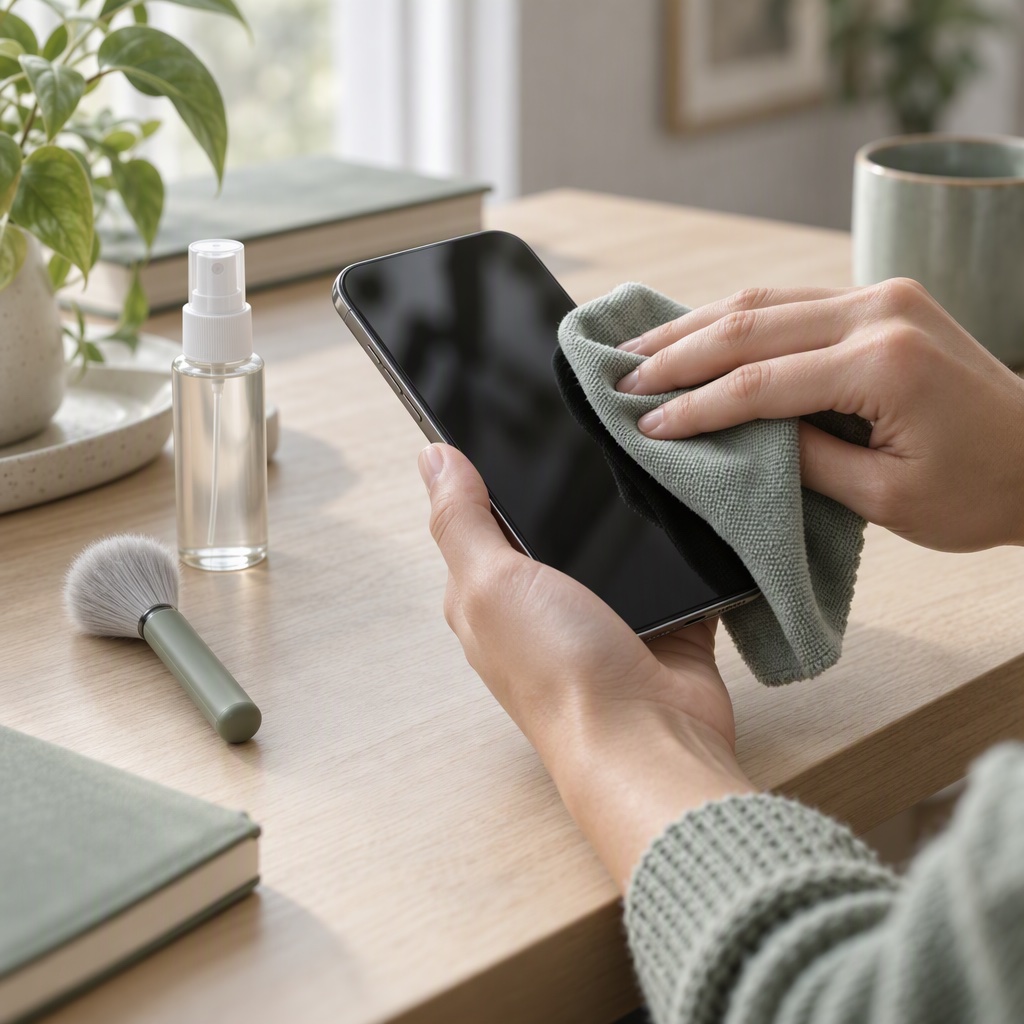
A phone screen is a surprisingly good collector of the things that make allergy symptoms worse: pollen, house dust, skin flakes and fibres all settle on the glass and then transfer to your hands and face. Nothing here is a treatment, and if your symptoms are persistent they belong with a doctor. What a regular cleaning routine can do is stop your phone from acting as a small, warm, frequently touched reservoir that re-exposes you throughout the day, especially during pollen season.
- Phone screens collect pollen, house dust and skin debris the same way any smooth surface does.
- Wipe the screen and back once a day during pollen season, and after every outing.
- A barely damp, lint-free cloth lifts allergens better than a dry wipe that just moves them around.
- Wash your hands before handling the phone, and consider keeping it out of the bedroom.
What allergens actually end up on a phone screen?
Whatever is in the air settles on a flat, warm surface, and a phone screen is exactly that. Pollen grains carried indoors on clothes and hair land on the glass and stay there until something moves them. House dust is a mixture of skin flakes, textile fibres, and the debris of dust mites, and it accumulates fastest around the rim of a case and the raised edges of a screen protector. Fibres from sofas, carpets and bedding transfer onto the phone whenever you set it down, and pet dander clings to the same oily film that fingerprints leave behind. The back panel collects just as much as the front, and stick-on grips, rings and card pockets create seams where fine particles gather. None of this means your phone is unusual, only that it is one of the most handled objects you own.
How does a phone transfer allergens to your face?
You hold the phone against your face for calls, and you touch the screen and then touch your face, hair or food many times a day. Anything sitting on the glass is available for that transfer, which is why the phone screen matters more than, say, a shelf. Skin oils from your fingers create a slightly sticky film that holds particles in place rather than letting them fall away, so the build-up compounds over a week of light wipes. Phone cases and fabric straps make the same point in reverse: a fabric lanyard or a knitted cover traps far more dust than a smooth case and releases it gradually whenever you handle it. Knowing this helps you decide where to focus. Wiping the glass is the highest-value habit, and a smooth case is easier to keep clean than a textured one.
How often should you clean a phone during allergy season?
Daily is reasonable during high pollen counts, particularly after you have been outdoors or on public transport. A quick pass with a barely damp cloth takes seconds and prevents the film that dry wiping tends to spread around. On low-pollen days, every two or three days is usually enough. The case matters at the same interval: a case traps dust at its seam and re-deposits it onto the phone every time you remove it, so take the case off weekly and brush out the interior. If someone in your household is sensitive, keep the phone off bedside tables and pillows overnight and give it a wipe before bed. Our guide to cleaning a phone without damaging it covers which liquids are safe if you are unsure.
What cleaning routine actually reduces build-up?
Power the phone down, remove the case, and start with a dry, soft brush or cloth to lift loose particles rather than grinding them into the surface. Follow with a barely damp microfiber cloth on the glass, working in one direction so you are lifting the film instead of dragging it across. Finish with a dry pass to remove streaks and any remaining moisture near the edges. Pay particular attention to the rim where the case sits, the camera lens ring, and any raised lip around a screen protector, since those hold the most debris. Wash hands before you start so you are not adding fresh oils to the surface. This whole routine takes about three minutes, and the barrier it breaks up is the point rather than the shine you leave behind.
Does a screen protector make cleaning easier or harder?
A smooth glass protector is slightly easier to wipe than a bare screen because it gives you a hard, uniform surface with a defined edge. The trade-off is that the border of the film is a perfect dust trap: particles lodge against the raised edge and are re-deposited onto the glass when you wipe over them. A full-coverage film with clean, flush edges collects less, and a case that overlaps the film helps keep that seam sealed. Plastic film protectors are softer and can hold a fine static charge that attracts dust, so they need slightly more frequent attention. Whichever you use, wipe outward from the centre in one direction, and if an edge has begun to lift, fixing that lift will remove the trap entirely. Our guide on stopping a protector lifting explains the repair.
When should phone cleaning not be the answer?
Cleaning reduces what settles on the phone, but it does not change what is in the air in your home. If symptoms appear year-round rather than during a pollen window, the source is more likely something else, and a doctor or an allergist can help you work out what. Similarly, if a rash appears around the ear or along the side of the face where the phone rests, that is worth raising with a clinician rather than treating as a cleaning problem. Some people react to case materials themselves, and switching to a plain, smooth case is sometimes informative. Keep expectations realistic: a clean phone is one less daily re-exposure among many, not a fix on its own. Reading up on anti-microbial phone case claims is useful if you are wondering whether a specialty case is worth it.
Frequently asked questions
- Do phone screens really hold more allergens than other surfaces? They hold less than soft furnishings such as bedding or a sofa, but because you handle a phone constantly and hold it near your face, the transfer rate is much higher than for a shelf or a table.
- Are alcohol wipes bad for a screen protector? Wipes containing a high concentration of alcohol can dull a plastic film over time and can creep into the edges of a glass protector. A barely damp cloth with a cleaner meant for electronics is gentler and just as effective.
- Should I clean my phone after every time I go outside? A quick wipe of the screen and back is sensible during high pollen days, especially if you have been in a park or garden. It takes seconds and keeps the film from building up between deeper cleans.
- Can a phone case cause allergy-like symptoms on its own? Possibly, if you react to a particular material or dye. Light-coloured smooth silicone tends to be the least reactive option, and switching to a plain case for a couple of weeks is a reasonable way to test it.
- Is it worth keeping the phone out of the bedroom at night? Many people find that reducing handled objects near the pillow helps them sleep better, and it also removes a source of allergen right beside your face for eight hours. A stand on the far side of the room works well.


