
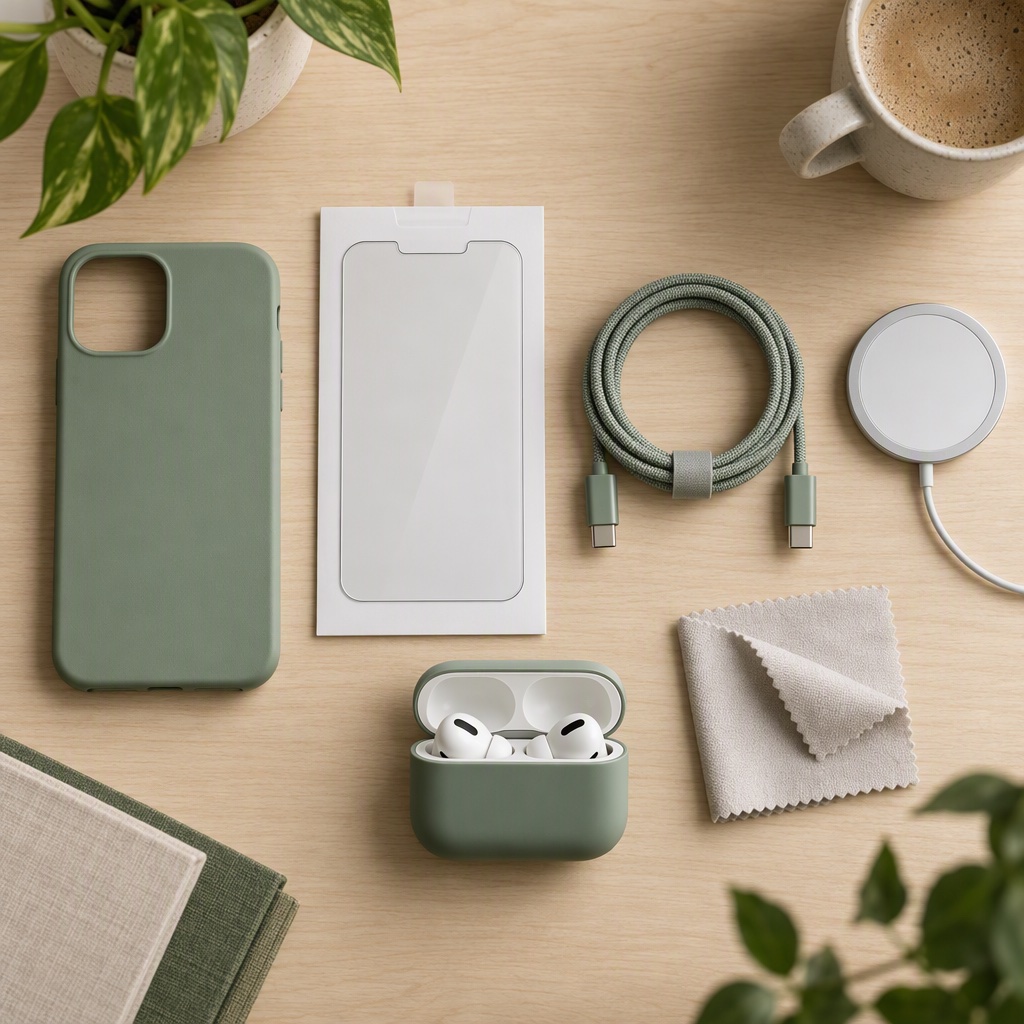
Storing phone accessories well comes down to three habits: separating what you use daily from what you use rarely, keeping cables from turning into knots, and keeping everything dry and at room temperature. You do not need special furniture or a tidier personality — a drawer, a box, and a couple of small pouches will do the whole job.
- Sort by how often you use each item; the daily things stay within reach and everything else goes in a closed box.
- Coil cables loosely with one tie per cable, so the connector ends are not bent against the coil.
- Keep everything dry and away from heaters, windows, and direct sun.
- Wipe cases and straps clean before storing them so grime does not sit on the material for months.
What should I separate first?
Start by sorting everything into three piles: what you touch every day, what you use weekly, and what you only need occasionally. The daily pile — your case, your usual charger, the cable that lives in your bag — should stay where you can grab it without looking. The weekly pile can go into an open tray or the front of a drawer. The occasional pile, which is usually bigger than people expect, is what deserves a closed box: travel adapters, a spare power bank, old phones, and the mystery cables you cannot identify. If an accessory has not been used in a year, it belongs in the occasional box or the recycling, not in the drawer you open every morning. That occasional pile also grows the fastest, so audit it twice a year rather than never.
How do I store cables without making a knot?
The trick is to store every cable the same way, loosely. Wrap it in a few wide loops around your hand rather than a tight coil around the connector, because tight coils bend the wire exactly where it is weakest. Give each cable its own tie — a hook-and-loop strap, a twist tie, or one of the rubber bands you have had forever — and let the connector ends hang free. Store cables by type so you are never untangling a charging cable from an audio cable in a hurry. If you own more cables than chargers, keep two or three in active use and store the rest separately so the drawer does not refill itself overnight.
Where should spare cases and protector films live?
Flat, cool, and dry is the whole answer. A drawer away from a radiator or a sunny window is ideal, because heat softens adhesives and bends plastics, and sunlight yellows clear materials faster than use ever will. Store spare screen protectors flat and in their sleeves, ideally standing up on their long edge like books, so nothing presses on the adhesive side. Old cases can be stacked, but do not store a phone inside a closed case for long periods — condensation can build up between them, especially if the case went into storage slightly damp. A silica gel packet is a cheap way to keep a storage box dry; replace it every few months. And if you are keeping a protector for a phone you no longer own, label the sleeve or let it go.
How do I clean accessories before storing them?
Wipe the case with a barely damp cloth, dry it off, and then let it sit out of the sleeve for an hour so the last of the moisture leaves. Straps and lanyards can be wiped or gently hand-washed if the material allows it — check the care tag — and they must be completely dry before they go into a box, or you are simply storing mildew for later. Avoid solvents on silicone and leather; plain water and a soft cloth handle almost everything a phone accessory can throw at you. This is also the moment to check straps for fraying and cables for kinks. Storing a damaged cable is just saving a problem for a future date, and it takes two seconds to notice now instead of discovering it at an airport.
What about power banks and chargers?
Power banks like the same conditions you do: room temperature, dry air, and no pressure on the casing. Do not store one in a car glovebox in winter or summer, and do not bury it at the bottom of a bag, where the ports can be crushed or shorted against keys and coins. If a bank has been sitting for months, check its case for swelling or damage before you use it, and give it a slow top-up before you rely on it for a long day out. Wall chargers and cables belong in a separate small box from banks and batteries, so nothing heavy lands on them. Inspect any bank that has been through a wet summer in a beach bag before it goes back into the box.
How do I keep the system from falling apart again?
Give the storage a home and a reset day. A small tray or dish by the door catches the stuff you carry in — cables, earbuds, the power bank — and stops it migrating to the sofa cushions. Once a month, do a five-minute reset: everything back in its pile, the daily items topped up, the occasional box closed again. If you share a flat, the rule that saves the most arguments is one drawer per person, because shared accessory drawers always become one person’s junk drawer with someone else’s cables in it. And if an accessory keeps going missing anyway, that is a storage problem too — our guide to how to stop losing your phone pairs well with this, and cable management on a home desk covers the desk half of the same problem in more detail.
Frequently asked questions
- Can I store phone accessories in the bathroom? It is the worst room for it. Steam raises the humidity around cables and connectors, and metal contacts corrode faster than you would expect. Keep the drawer, box, or pouch somewhere dry and ventilated instead, and never store a power bank near a sink.
- Is it safe to keep a power bank in a drawer? Yes, as long as the drawer is at room temperature and the bank is not crushed by other items or pressed against keys and coins. Look it over every few months for swelling, damage, or an unusual smell, and store it away from anything flammable.
- Should I keep the original boxes for cases and protectors? Only if you move house often or resell accessories, because otherwise the packaging takes up far more space than the contents. A simple labelled box beats a cupboard of boxes every single time.
- How often should I clean accessories in storage? Every two or three months is plenty. Wipe the case you actually carry, and just dust-check the stored ones so you catch damp, smells, or dye transfer early rather than in the middle of a trip.
- What is the best way to store a spare screen protector? Flat, in its sleeve, standing on its long edge in a cool drawer. Heat is the real enemy of the adhesive layer, so avoid any spot that gets warm, and keep the sleeve sealed until the day you fit it.


