
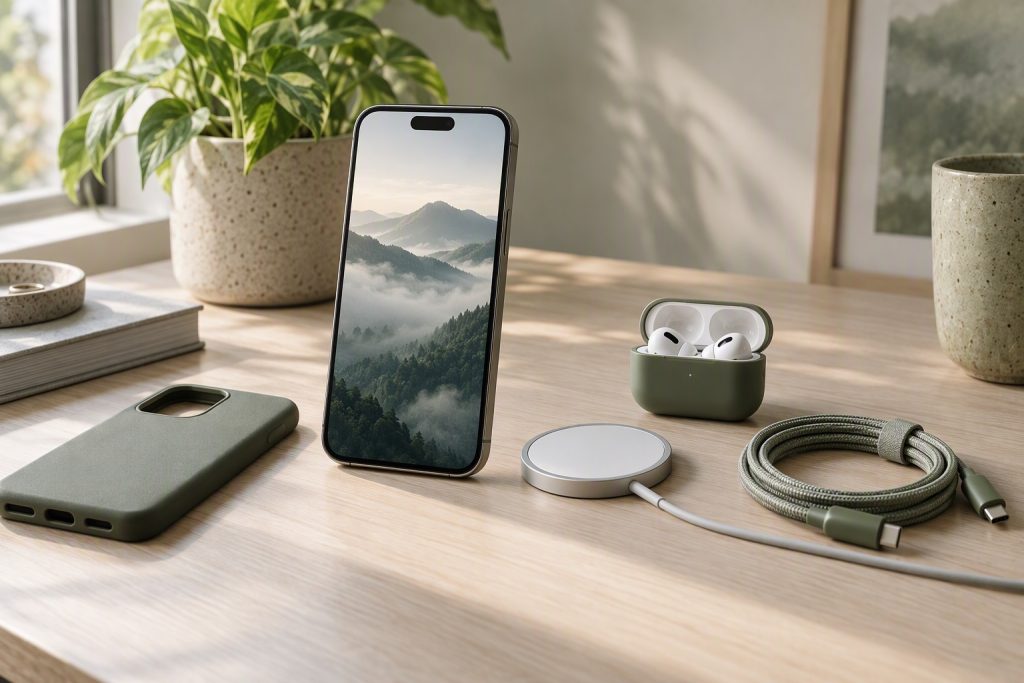
A student phone needs far fewer accessories than the shops suggest. In practice, most of the value comes from a short list: a case that fits, a screen protector, a charger and cable, and a power bank for long days. A strap or lanyard helps if you move between rooms a lot, and a simple stand earns its place if you use the phone for study. Everything else is optional, and the honest test for any accessory is whether it solves a problem you actually have during a normal week. If it does not, it belongs in a drawer, not in your bag.
- Protection first: a fitted case and a cleanly applied screen protector.
- Power second: one wall charger, one cable, and a compact power bank.
- Carrying third: a strap or lanyard so the phone stays with you between classes.
- Skip the rest until a real problem appears — most accessories solve problems students rarely have.
What does a student phone actually need?
A student phone needs protection, power, and a way to carry it. That is the whole framework. Protection means a case that fits the exact model and a screen protector that sits flush; together they prevent the two most expensive accidents, a cracked screen and a damaged camera. Power means a charger that lives in your bag or dorm, a cable long enough to be useful, and a power bank for days that run long. Carrying means keeping the phone attached to you rather than trusting a pocket or the bottom of a backpack. Add a stand only if you watch or study on the phone at a desk. Everything beyond this list is a preference, and preferences should be bought one at a time as you notice you want them, not all at once on a first shopping trip. Write the list down and add to it only when something actually goes wrong.
iPhone Cases — case. Designed for everyday carry and backed by our 30-day happiness guarantee.
Which accessories solve the biggest problems?
Ranked by how much trouble they prevent, the case comes first, because a drop in a corridor is the most likely accident and the cheapest to avoid. The screen protector comes second, since scratches build up quietly and never come off. The power bank comes third, because running out of battery is annoying rather than destructive, but it happens often. A strap comes fourth, and it earns its place mainly for students who move between buildings or take public transport. Notice that none of these are exciting purchases. The accessories that prevent problems tend to be dull, and the ones that look most fun — novelty cases, extra cables in odd colors, mounts for a car you do not drive — usually sit unused after the first week. Buy for the problem, not the shelf. A cheap accessory that solves nothing is still expensive, no matter what it cost.
What about carrying the phone around campus?
Campus life is a series of short trips: room to class, class to library, library to a friend’s place. Each one is a chance to set the phone down and leave it. A lanyard or a crossbody strap removes that risk by keeping the phone on your body instead of in a loose pocket or an open bag. A wrist strap works for students who keep everything in their hands, while a crossbody strap suits those who carry a backpack and want the phone reachable without unpacking. Whichever you choose, the strap should attach to the phone or its case securely, and the length should let you use the phone without taking it off. Check the attachment point every week, since that is the part that wears. If you often go without a bag, read how to carry a phone without a bag.
How does charging fit into a student day?
Charging is less about speed and more about coverage. A student day often starts at home or in a dorm and ends somewhere without a socket, so the useful setup is a charger for the wall and a power bank for the hours in between. Keep one cable with the charger and one with the bank, or use a cable you can move between them. A charger with more than one port is handy if you also charge earbuds or a laptop. Capacity matters less than habit: a small bank you remember to charge each night beats a large one that sits flat. Choose a size you are happy to carry, and treat topping it up as part of the same routine as charging the phone itself. If you get that habit right, you rarely notice the gear at all, and the goal is a setup you never have to think about.

MagSafe & Charging — charger. Designed for everyday carry and backed by our 30-day happiness guarantee.
Which accessories are a waste of money for students?
The clearest waste is a second case for a phone you already protect well, since it adds nothing except a choice you will not make. Next is a spare cable kept in a drawer at home, where it cannot help. Mounts for a car, a bike, or a desk you do not use are common impulse buys that rarely get touched. Very cheap charging gear is a false economy, because a cable that fails in a month costs more than a slightly better one that lasts the year. And any accessory that adds bulk to a phone you carry all day will be left behind sooner or later. If you cannot name the moment in your week when you will use something, that is usually the answer. Being honest about that one question saves more money than any sale.
How do you build the kit over time?
Build the kit one problem at a time rather than all at once. Start with a case and a screen protector before the term begins. Add a charger and cable if you do not already have a good one. Wait until you run out of battery once or twice, then buy a power bank sized to your day. Add a strap the first time you nearly leave the phone behind, and a stand the first time you want to read or watch hands-free. This way every item answers something real, and you never carry weight you do not need. A kit built this way also costs less up front, because you are not guessing at what you might want. Compare it against what you already own before buying anything new. For a ready-made list to check against, see phone accessories for students: a starter kit.
Frequently asked questions
- What are the absolute essentials? A fitted case, a screen protector, a charger, and a cable. A power bank and a strap come next, once you know you need them.
- Do students need a power bank? Only if your day regularly runs longer than your battery. A compact one you charge nightly is enough for most schedules.
- Is a lanyard worth it? It is if you move between rooms and buildings all day and tend to set the phone down. It keeps the phone on you rather than in a bag.
- Should I buy a stand? Yes, if you study, read, or watch on the phone at a desk. It also helps for video calls and filming coursework.
- How many cables do I need? Two is usually plenty: one that stays with the charger and one for your bag. More cables mostly create clutter.


