
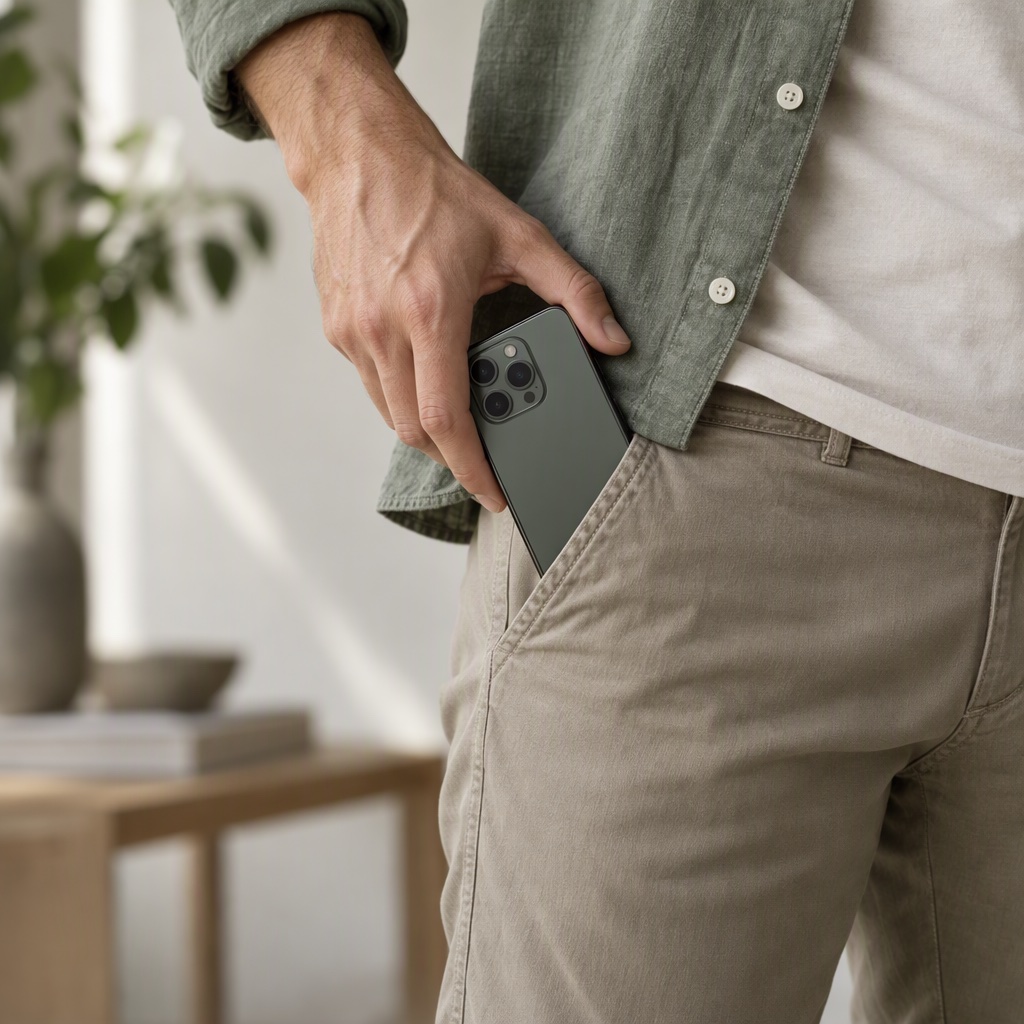
A privacy film is a thin screen layer that narrows the viewing angle of your phone, so the display stays readable when you look at it straight on but fades out for anyone viewing from the side. It is a simple idea: instead of sharing your screen with the person beside you on a train or in a queue, you keep the content to yourself. Privacy films are not for everyone, and they come with trade-offs in brightness and clarity, but for people who read sensitive things in public they solve a real problem.
- A privacy film narrows the viewing angle so your screen is hard to read from the side.
- It suits people who handle private information in crowded public places.
- Expect some loss of brightness and sharpness, especially in bright light.
- If you mainly want protection, a clear protector is the better choice.
What is a privacy film and how does it work?
A privacy film is a screen protector with a special structure that limits the angle from which the display can be seen. Look at the screen directly and it reads normally; move to the side and the image dims or disappears into a dark tint. The effect comes from the way the film directs light, not from any software or setting. Most privacy films are applied like any other screen protector, over the glass, and they add a small amount of thickness. They also protect the screen from scratches in the usual way, so they do two jobs at once. The strength of the privacy effect varies between films, and so does the amount of light they let through. The film works by narrowing the viewing angle, so only someone directly behind you sees the screen.
Who actually needs one?
A privacy film is genuinely useful for anyone who reads private information in crowded places. That includes people handling client details, messages, or financial information on a commute, and anyone who works on a phone in a busy waiting room, cafe, or airport. It is also handy for students and workers who take the phone into shared spaces where a shoulder-surfer could read over them. It is less useful for people who mostly use the phone at home or in private, where nobody is looking at the screen anyway. The honest test is simple: if you have ever angled your phone away from someone to hide the screen, a privacy film is doing that job for you automatically. If you have not, you probably do not need one. It is most useful on public transport and in open-plan offices, where shoulders are constantly nearby.
What are the trade-offs?
The main trade-off is brightness. Because a privacy film blocks light from the sides, it also reduces the light reaching your eyes from the front, so the screen can look dimmer and less punchy, especially outdoors. Some films also soften fine detail slightly, which matters if you read small text or edit photos. A second trade-off is that the phone becomes harder to share: showing someone a photo or a video means they have to sit directly in front of the screen, and two people cannot easily watch together. The film also needs to be applied carefully, since bubbles or a lifted edge spoil both the look and the effect. None of these are dealbreakers, but they are reasons to choose a privacy film only when you actually want the privacy. A film adds a slight grain to the display, which most people stop noticing within a day.
What else keeps a screen private in public?
A film is not the only option, and sometimes it is not the best one. A privacy pouch, which is a sleeve that blocks the screen from view, protects the phone when it is stored rather than when it is in use, so it suits people who only want to keep the screen hidden between glances. A fold-over case does something similar, hiding the display when the cover is closed. Habits matter too: turning the phone away from the person beside you, lowering the brightness, and avoiding sensitive screens in crowded places all reduce the risk without any accessory at all. For some people the simplest answer is a combination. For more, see what belongs in a phone pouch and what does not. Pair it with a case that has a cover if you want full privacy, since the film only protects the front.
Does a privacy film affect brightness or touch?
Brightness is the part most people notice. A privacy film dims the display from the front, so you may find yourself raising the screen brightness, which uses more battery. In bright outdoor light the effect is more obvious, and the screen can look washed out. Touch response is usually unaffected, since the film is thin and sits over the glass like a normal protector, though a poorly fitted or thick film can feel slightly less responsive at the edges. Color can shift a little depending on the film, so photos may not look exactly as they did before. If you care most about picture quality, a clear protector is the better choice; if privacy matters more, the brightness cost is the price you pay. Apply it in a dust-free spot, because a trapped speck under the film is visible every time you unlock.
How do you choose and fit one?
Choose a privacy film by matching it to your priorities: stronger privacy usually means a dimmer screen, so decide which matters more before you buy. Check that the film is made for your exact phone model, including any curved edges, since a film that does not match the glass will lift at the corners. When fitting it, clean the screen thoroughly, work in a low-dust room, and line up the camera and speaker openings before you press it down. Push out bubbles from the center outward. If the film lifts at an edge, a case with a raised lip can press against it, so check the fit with the case on. For the wider topic, read how to keep your phone secure in public.
Frequently asked questions
- Does a privacy film really work? Yes, from the sides. It narrows the viewing angle so the screen is hard to read unless you are looking at it directly.
- Will it make my screen dimmer? Usually a little, and more noticeably in bright light. Stronger privacy generally means more brightness lost.
- Can two people watch the screen together? Not easily. Both need to sit directly in front, which makes sharing a video awkward.
- Is a privacy pouch better than a film? They do different jobs. A film hides the screen while you use it; a pouch hides it while it is stored.
- Do I still need a screen protector? A privacy film protects the screen as well, so you do not need a separate protector on top of it.


