

A kayak is one of the least forgiving places for a phone. There is water in every direction, the deck is wet, your hands are busy, and anything you drop is gone. The phone can still come with you, but only if it is sealed, attached, and used sparingly. The approach that works is to treat the phone as cargo first and a camera second: keep it closed and tethered while you paddle, and take it out only when you are stable and stopped.
- Seal the phone in a pouch before you get on the water, not after.
- Tether the pouch to the boat or to you, so a slip is not the end of it.
- Keep the phone stowed while paddling and use it only when stopped.
- Keep the screen dimmed and the phone out of the sun to save battery.
Where should a phone go on a kayak?
Somewhere it cannot fall overboard and cannot be crushed. A sealed pouch clipped to a deck line or a seat strap works well, because the phone stays inside the boat even if the pouch slips. A pocket in a spray skirt is convenient but only as secure as the closure, so check it before you launch. Avoid loose storage in the hull, where water collects, and avoid anything resting on the deck where a wave can wash it away. If you keep the phone on your body, put it in a pouch on a crossbody strap worn under your outer layer, so it cannot swing or snag on the paddle. The test is simple: shake your setup gently and see whether the phone moves somewhere it should not.
How do you keep a phone dry while paddling?
Use a sealed pouch rather than relying on the phone’s own water resistance. Splashes, drips from the paddle, and the wet floor of the boat all add up, and a phone that gets soaked slowly is worse off than one that gets a quick dunk. Seal the pouch before you launch and check the closure again whenever you take the phone out. Keep the pouch away from sand, since a grain caught in a zip or a roll-top clip will hold the seal open. If your pouch has a window, make sure it is clean enough to shoot through before you set off. It is also worth testing the seal at home with a tissue inside, which takes a minute and tells you whether the pouch is still trustworthy. Our explanation of waterproof and water-resistant phone cases covers the difference.
What mount works on a kayak?
Mounts on a kayak are a compromise. A clamp or suction mount needs a flat, dry surface, and a kayak deck is rarely either, so suction mounts are unreliable on the water. A strap or rail mount attached to a deck line is more dependable, as long as it does not interfere with your paddle stroke or your spray skirt. Some paddlers use a mount on the front deck to record forward-facing video, but the phone is then exposed to spray and sun for the whole trip, which is hard on both the phone and the battery. If you want footage, a short recording session at a scenic point is safer than leaving the phone mounted for hours. Whatever you choose, attach a tether as well, so a failed mount costs you a pouch rather than a phone.
How do you take photos from a kayak?
Stop paddling, let the boat settle, and then take the phone out. Shooting while moving produces blurred photos and puts the phone at risk, and you cannot brace yourself against a wave while holding a camera. Sit facing the subject with your knees braced against the hull, keep both hands on the phone, and shoot in short bursts rather than holding it up for a long time. If you need a better angle, a small grip attached to the back of the case gives you a secure hold and lets you shoot one-handed when you need to steady yourself with the other. Keep the phone low over the deck rather than out over the water, so a slip lands inside the boat. Dry your hands first, because wet fingers and smooth glass are a poor combination.
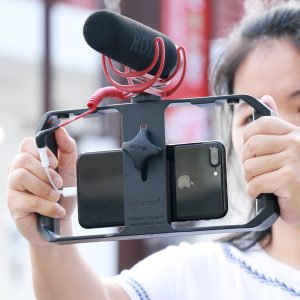
Grips & Ring Holders — holder. Designed for everyday carry and backed by our 30-day happiness guarantee.
What about charging and battery on the water?
A phone on the water works harder than usual: the screen is bright against the glare, the camera is running, and cold water or wind can affect the battery. Keep the screen dimmed and use airplane mode when you do not need a signal, since a weak signal on open water drains the battery quickly. If you need to charge, use a power bank kept in a dry bag rather than a pouch, and connect it while both are sealed and shaded. Wireless charging is a poor fit on a kayak, because it is slower and generates more heat inside the pouch. If the trip is long, consider leaving the phone stowed for most of the day and charging it in the evening, when the boat is on shore. Our guide to choosing a power bank is a useful starting point.
What should you check before you launch?
Run through the same list every time. Is the pouch sealed, with no sand or hair in the closure? Is it tethered to the boat or to your body? Is the phone charged, and is the screen locked so it does not wake in your pocket? Have you dried the outside of the pouch so you can handle it with wet hands? Is the phone set to a sensible brightness, and are notifications silenced so it does not buzz constantly? Finally, decide in advance when you will use the phone and when you will leave it alone. A quick check on the shore takes two minutes and prevents the most common accidents, most of which happen in the first few minutes on the water or during a hurried photo.
Frequently asked questions
- Can I use a phone on a kayak without a pouch? Only if you keep it inside a dry bag and never open it on the water. A phone’s own water resistance is designed for accidents, not for a day of spray and a wet deck, so a pouch is the safer choice.
- Will my phone float if I drop it? Most phones sink, and so do many pouches. A floating pouch or a strap attached to the boat is what keeps a dropped phone recoverable, so treat flotation as essential rather than optional.
- Is it safe to use a suction mount on a kayak? Rarely. Suction needs a flat, dry, smooth surface, and a kayak deck is usually none of those. A rail or deck-line mount with a tether is more dependable.
- How do I stop the screen from fogging in a pouch? Warm, humid air trapped inside the pouch can fog the window. Seal the pouch on shore in the shade rather than in the sun, and avoid opening it on the water where damp air gets in.
- Should I keep my phone in airplane mode on the water? It is a good idea if you do not need a signal. A phone searching for a weak signal on open water uses more power, and airplane mode keeps the battery going for longer.


