
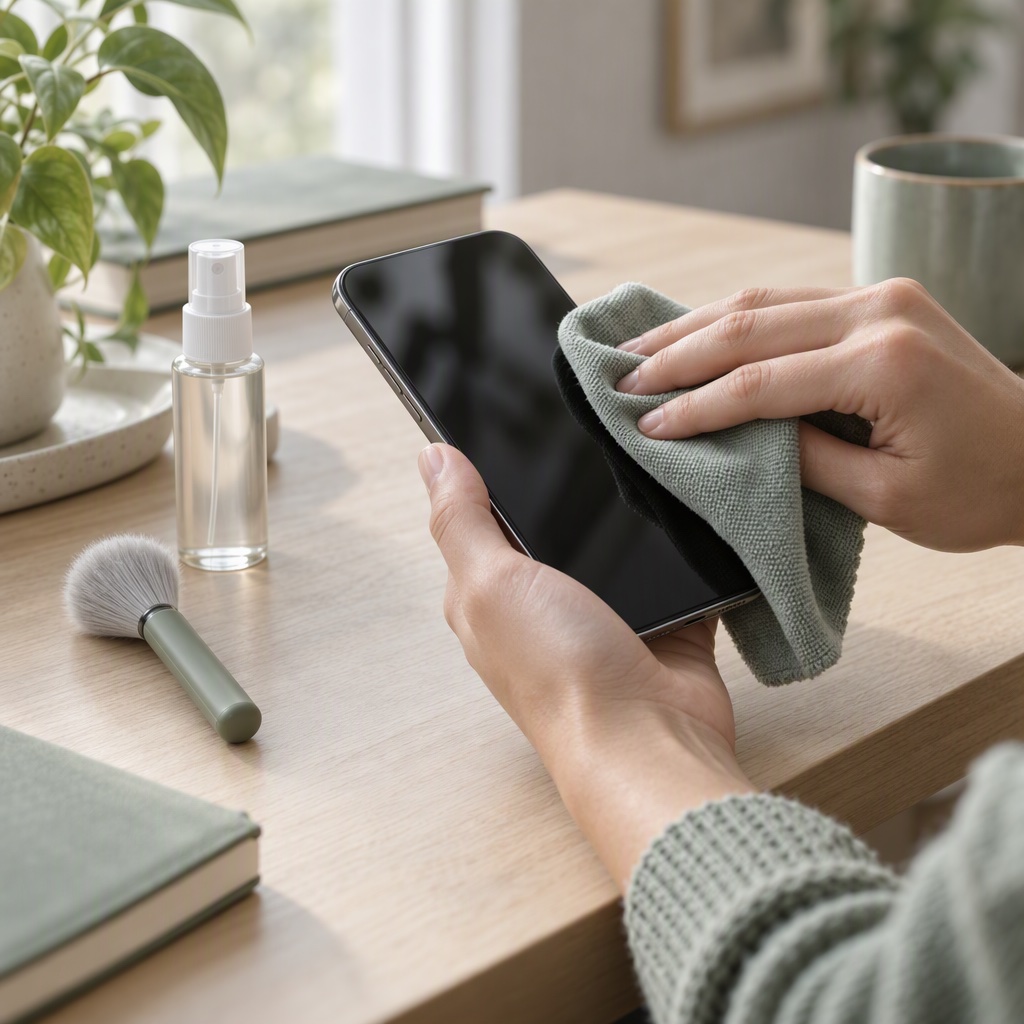
A phone wipe disinfectant does exactly what it says: it kills or deactivates a large share of the bacteria and viruses sitting on the surface of a phone, and then evaporates quickly enough that it does not seep into the ports. It is not a deep clean, and it will not do much about dust or grit. Used alongside a proper wipe-down with a cloth, it is the step that deals with the things you cannot see.
- Wipes are for germs, not for dust: brush or wipe first, then disinfect.
- Look for alcohol-free or low-alcohol formulas if you have a coated screen or a plastic film.
- Never spray the phone directly; apply the product to the cloth or wipe.
- Keep liquid away from ports, speaker grilles and the edges of a screen protector.
What does a phone wipe actually disinfect?
It targets the surface layer of the phone. A phone carries the bacteria from everywhere you take it, plus whatever is in the air, and a disinfecting wipe reduces that population when you wipe the glass and the back. The important detail is contact time: a wipe only works if the surface stays visibly wet for the time stated on the product, usually several seconds, which means one quick pass over a dry screen may not do much. It is also a surface treatment, so it does nothing about dust in the charging port or crumbs in a case seam. Think of it as one step in a routine rather than a stand-alone product.
How is a disinfecting wipe different from a screen cleaner?
A screen cleaner is designed to lift fingerprints, skin oils and smears, and it evaporates without leaving residue. A disinfecting wipe is designed to reduce microbes, and it may be harsher on coatings while doing nothing at all about smears. The two jobs overlap, which is why many people use both: a cleaner for the daily pass, and a disinfecting wipe occasionally when the phone has been in a shared space or a bathroom. Using a disinfectant as your everyday cleaner is not harmful in itself, though it often leaves the screen duller than a proper cleaner would. The reverse, using a cleaner and expecting it to disinfect, simply does not work. Keeping both in the drawer is cheap and means you use the right one for the job. Our guide to cleaning a phone without damaging it covers which liquids are safe.
What should you avoid in a formula?
High concentrations of alcohol, ammonia and bleach are the three things to watch. Alcohol evaporates quickly and disinfects well, but over months it can dull an oleophobic coating and can creep into the edge of a plastic screen protector and lift it. Ammonia is common in glass cleaners and can be too aggressive for a coated screen. Bleach is effective but corrosive, and it will damage a case as readily as it disinfects a phone. If you have a clear plastic case, be aware that strong disinfectants can also yellow the surface over time. The safest approach is a cleaner marketed for electronics, used sparingly, with a cloth rather than sprayed directly. If the only thing you have is a strong disinfectant, use it on the case and the back panel rather than the screen.
How do you disinfect a phone properly?
Power the phone down first, and take it out of its case so you are not cleaning around a seam that is trapping dirt. Remove loose dust with a dry brush or cloth, because a disinfectant does not remove grit and can grind it into the surface. Then apply the wipe or cleaner to the cloth, not to the phone, and wipe the screen, the back and the edges of the case. Give the surface a few seconds of contact time rather than one pass, then dry it fully with a lint-free cloth. Keep the liquid away from the charging port, the speaker grilles, the microphone holes and the raised edge of a screen protector. Wash your hands afterwards, and put the case back on only when the phone is dry. The whole thing takes about two minutes, and it is most useful after using the phone in a shared or public space.
How often should you disinfect a phone?
There is no single correct interval, and more is not automatically better. A reasonable habit is a daily wipe with a soft cloth to lift oils, and a disinfecting pass once or twice a week, or after a specific event: a trip on public transport, using the phone in a bathroom, sharing it with someone, or being around someone who is unwell. If you work in a healthcare setting or handle food, follow the guidance for your workplace, which will be more specific than anything here. Between disinfecting, do not let the phone sit face down on a kitchen counter or a bathroom shelf, because that is where most surface contamination is picked up. Reading the label on the product is the most reliable guide to contact time and dilution.
What about cases, straps and other accessories?
Cases deserve more attention than phones, because their seams trap more and they are harder to wipe. Silicone cases can be washed in warm soapy water and dried fully; that single habit does more than any disinfectant applied to the outside. Leather and fabric cases should be wiped rather than soaked, and anything with a glued-on magnet or a strap should stay dry. Straps, lanyards and crossbody pouches collect sweat and hand cream in their fibres, so brush them gently and wipe any metal clasps with a barely damp cloth. Card sleeves and wallet pockets are easy to wipe by hand and are worth cleaning more often than most people do. A quick pass over earbuds and their tips, with a dry or barely damp cloth, is a good habit to add at the same time, since they sit in your ears. Our notes on cleaning a phone case properly cover the materials in detail.
Frequently asked questions
- Can a phone wipe damage my screen? A wipe made for electronics is safe with normal use. Strong disinfectants, especially high-alcohol formulas, can dull a coating over time and can lift the edge of a plastic screen protector, so use them sparingly on the screen itself.
- Do disinfecting wipes work on a phone’s plastic case? They can, but soap and water is more effective on the seams of a silicone case. Repeated strong disinfectant use may yellow clear plastic, so reserve wipes for occasional use.
- Should I disinfect my phone after being in a public place? It is a reasonable habit, particularly after using the phone on public transport or in a restroom. Power it down, wipe the screen and back, and keep moisture away from the ports.
- Is a UV sanitiser better than a wipe? A wipe physically removes soil as well as reducing microbes, which a light-based sanitiser cannot do. If you use a UV device, it works best on a phone that has already been wiped clean.
- How do I clean a phone if I am worried about liquid damage? Turn the phone off, put a small amount of cleaner on a cloth rather than the phone, avoid the openings entirely, and dry everything with a lint-free cloth straight afterwards.


