
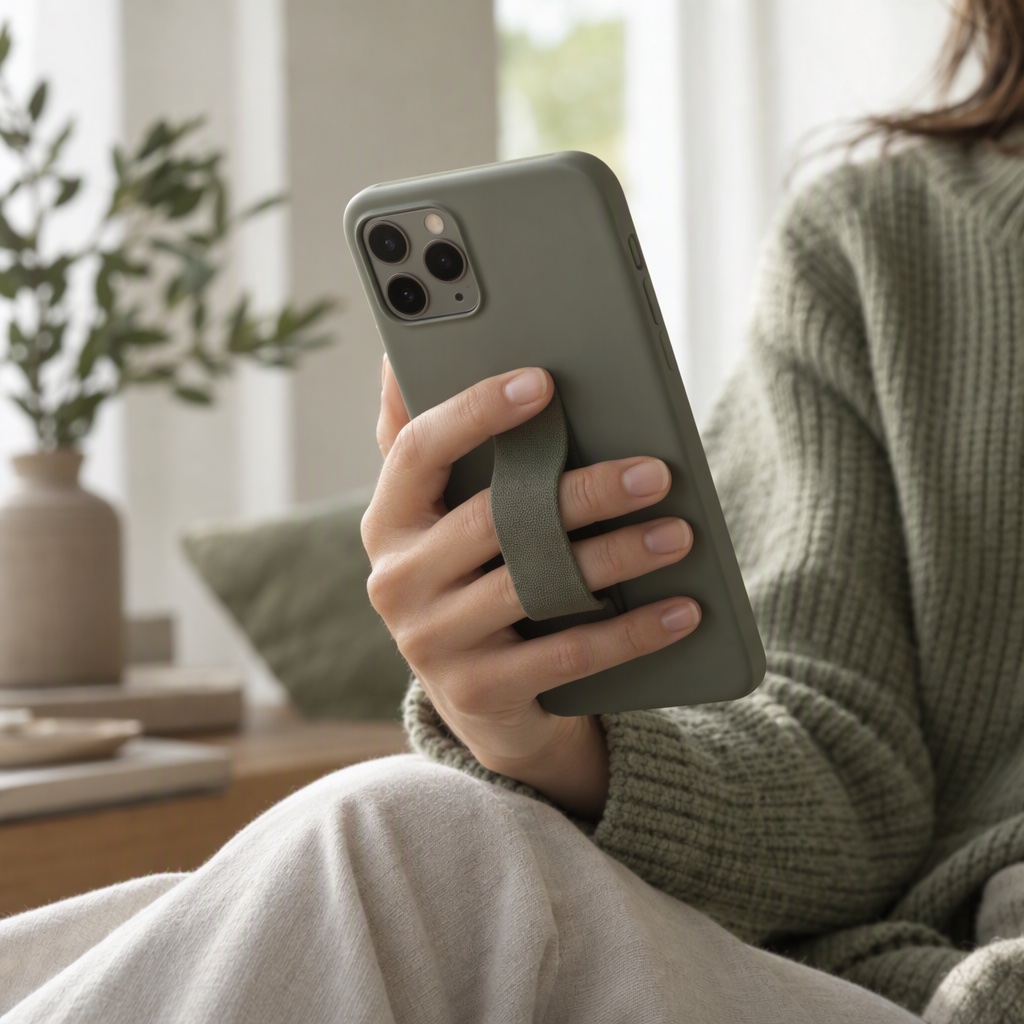
A crossbody phone lanyard is a strap that lets you carry your phone worn across your body instead of held in your hand or buried in a bag. One end holds the phone, usually through a case with a strap anchor or a small pouch, and the other end goes over your neck or shoulder so the phone rests against your chest or hip. It is built for the times you want your phone close, your hands free, and no bag to babysit: markets, festivals, dog walks, travel days, and quick errands.
- It keeps your phone close and your hands free without carrying a bag.
- Two main styles: a case with a built-in strap anchor, or a pouch the phone slides into.
- Best for short outings, travel days, and festivals; less suited to running or long hikes.
- Adjust the strap so the phone sits where you can see it and does not swing into things.
What is it actually for?
The point is hands-free carry with quick access. A phone in a bag is safe but slow, and a phone in your hand is fast but occupied — a crossbody lanyard sits between the two, keeping the phone at chest or hip height where you can glance at it and touch it without stopping. In crowded places, wearing it across the body with the phone in front is also the most secure way to carry one, because you can feel it and see it. Walkers, market trips, and festival days are the sweet spot: enough distance that carrying gets tiring, not so much distance that a bag is genuinely better. If your day involves more walking than carrying, that is the use case it was built for.
How is it different from a wrist strap or a neck strap?
It comes down to length and where the phone rides. A wrist strap is short and loops around one hand — it is designed to stop drops while you are actively holding the phone, like when you are leaning out to take a photo. A neck strap hangs the phone against your chest at a fixed length and works best when you are standing or sitting. A crossbody lanyard is longer, runs from shoulder to hip, and lets the phone hang at your side or ride in front of your body, which distributes the weight across a shoulder rather than concentrating it on your neck. Some designs convert between positions with an adjustable clip, which is worth looking for if you want one strap that does more than one job.
What can it carry besides the phone?
Small things only. Most pouches and case pockets will happily take one card, a folded note, a key, and maybe a small earbuds case — anything more than that and the strap starts pulling sideways, which is uncomfortable and looks odd. The honest test is weight: if you would not want that item resting on your chest for an hour, it does not belong on the strap. People who try to turn a lanyard into a purse usually end up frustrated, because the strap digs in and the contents shift every time you move. Our guide to what belongs in a phone pouch is a good sanity check before you load one up.
Will it work with the case I already have?
Only if your case has somewhere for the strap to attach. Many protective cases have small anchor slots at the corners, often hidden where the two halves of the case meet, and a lanyard tab threads through one. If your case is smooth all around with no slot, forcing a strap onto it is not a good idea — the adhesive tabs that exist for this fail eventually, and the phone pays the price. The alternative is a pouch style, where the phone slides into a fabric sleeve with a strap already attached, which works with any case thin enough to fit the sleeve. Measure your phone with its case on before buying a pouch, because wallet cases and thick bumpers often do not fit.
How do I wear it safely in a crowd?
Wear it across your body, not hanging off one shoulder, so the phone rides in front where you can feel it. In dense crowds, position the phone under a jacket or a buttoned layer if the design allows, and check the strap connection with a quick tug when you sit down. Be aware of snag hazards too: door handles, handrails, and bag straps have all ended engagements with crossbody lanyards, usually taking the phone with them. A strap that releases quickly under a hard pull is a genuine safety feature, not a gimmick, if you ride a bike or use escalators with an open bag. None of this makes you theft-proof, but it removes the easy grab.
Is it comfortable enough for a whole day?
For most people, yes, with two conditions: the strap must be wide enough, and the length must be right. Thin cords dig into a shoulder within an hour, while a wider, padded strap spreads the weight much better. Set the length so the phone sits where your hand naturally falls — usually around hip height — because a phone that hangs too high bounces against your stomach, and one that hangs too low swings into steps and door frames. Switch shoulders during a long day if one gets tired. If you carry more than a phone, our guide to how to carry a phone without a bag compares the strap options in more depth.
Frequently asked questions
- Can I use a crossbody lanyard for running? Not really. The phone swings and bounces with every stride, which is uncomfortable and eventually works the strap connection loose. A snug armband or a running belt handles movement far better, so if exercise is the goal, a different accessory suits you better.
- Will it fit a large phone with a bulky case? Check the pouch dimensions and the strap’s rated width before ordering. Large phones with wallet cases or rugged bumpers often do not fit pouches designed for slim phones, because slim pouches are usually sized for a bare or lightly cased phone.
- Is it secure against pickpockets? Wearing the phone in front, under a layer, helps a lot and beats an open backpack. No accessory is theft-proof, though — staying aware in crowded places is still the main defense, and the strap is the second line rather than the first.
- How do I clean a fabric lanyard? Wipe it with a damp cloth for everyday grime, or hand-wash it gently if the material allows, then let it dry completely before storing. Never machine-dry a strap with plastic clips on it, and dry it flat so the clips do not distort.
- Can I attach a lanyard to a magnetic case? Usually not, because most magnetic cases have smooth edges with no anchor slot. If you want both, look for a case that combines a magnetic layer with a strap anchor point, or choose the pouch style that fits over the case.


