A wallet case suits you if you want one object to carry and you accept that losing the phone means losing your cards with it. A phone pouch suits you if you would rather keep cards separate and protect the phone in its own padded compartment. Neither is better in the abstract, because the right answer depends on how many cards you carry, how often you swap bags, and how much you dislike carrying two things.
- A wallet case replaces a separate card holder but ties your cards to your phone.
- A phone pouch keeps cards separate and adds padding, but is a second object to carry.
- Choose a wallet case if you carry one or two cards and dislike extra pockets.
- Choose a pouch if you carry a full wallet anyway, or if you swap bags often.
What is the real difference between a wallet case and a phone pouch?
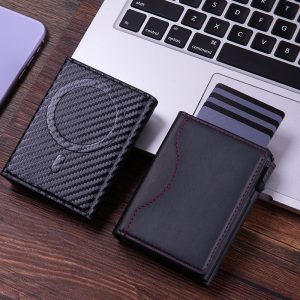
A wallet case is a phone case with card slots and often a folded note pocket built into the back or the front flap. It replaces your card holder, so you leave the house with one object. A phone pouch is a separate holder, either a padded sleeve or a belt pouch, that the phone slides into. It does not replace your wallet and it does not attach cards to the phone. The practical difference is what happens when you lose the phone, because with a wallet case your cards go with it while with a pouch your cards stay in your pocket.

Which one protects the phone better?
A pouch usually protects more, because it wraps the whole phone in padding rather than covering only the back and sides. A pouch also keeps the screen and the camera fully enclosed when the phone is not in use, so nothing can press on the glass in a bag. A wallet case protects like a normal case, covering the sides, corners and back, with a raised lip if it is well made. The gap narrows if you choose a wallet case with a magnetic closure and a raised camera ring, and widens if the pouch is a thin unlined sleeve. Check whether the pouch has a lining, since an unlined pouch offers padding without scratch protection.
What happens to your cards when the phone is lost?
With a wallet case, everything goes at once, and that is the strongest argument against one. You lose the phone, the cards and any cash in the flap, and you have to cancel all of it while you are already dealing with a missing handset. With a pouch, the cards stay wherever you keep them. If you do choose a wallet case, keep only one or two cards in it and leave anything hard to replace, such as an ID, a travel card or a building pass, in a separate pocket. Cancel the cards as soon as you are sure the phone is gone.
How do you decide based on your daily routine?
Count the objects you carry now. If you already carry a wallet and a phone, a pouch changes nothing except how the phone is stored, and it is the simpler upgrade. If you have been trying to drop the wallet, a wallet case does that in one move. Then look at your bag habit, because people who swap between a work bag, a tote and a jacket pocket do better with a wallet case since there is only one thing to move. People who use one bag every day can carry a pouch comfortably. Whichever you pick, the phone should still be hard to lift, and the basics of keeping a phone secure in public apply to both.
Can you use a wallet case and a pouch together?
You can, but think about why. A phone in a wallet case inside a pouch is well protected, but it is also thicker, and the pouch needs to be sized for the case rather than the bare phone. The usual reason to combine them is commuting, where the wallet case is what you carry to a shop and the pouch is where the phone lives inside a bag the rest of the time. If the pouch is too tight, the case edges press on the screen protector and lift it, so a little slack is better than a snug fit here.
Which one is easier to carry on public transport?
A pouch with a belt loop or a shoulder strap keeps both hands free, which matters on a moving carriage where you are holding a rail. A wallet case in a front pocket is quick to reach when you need a ticket or a card at a gate, but it is also the easiest thing to lift in a crowd. If you travel at peak times, the safer pattern is a pouch worn under a jacket plus a single card in a separate pocket. Whichever holder you choose, the glass is still the part that shows wear, and fitting a screen protector without bubbles is the follow-up job.
Frequently asked questions
- Is a wallet case safer than a separate wallet? No. It concentrates your phone and your cards in one object, so a single loss costs more and you have to cancel everything at once. It is more convenient rather than safer, unless you keep the number of cards in it very low and leave anything hard to replace at home. Treat the card slots as a convenience, not as secure storage.
- Can a wallet case hold a transit card without removing it? Only if the case has a shielded slot or an open window that lets the reader see the card. Many cases block contactless readers because the material is too thick or the card sits behind a metal plate. Test the card at a gate on a quiet day before you rely on it at a busy turnstile.
- Does a phone pouch fit a phone with a case on? Only if the pouch is sized for the case rather than the bare handset. A pouch that fits a bare phone will not close over a wallet case, and forcing it will press on the screen. Choose the pouch last, once you know how thick the phone will be, and check the internal depth before you buy.
- Will a wallet case block wireless charging? It can, because the cards and the folded flap add thickness between the phone and the charging coil. A magnetic wallet that detaches from the case solves this. If charging fails or slows, remove the cards and try again to confirm that the case is the cause. Metal cards and foil-lined slots are the worst offenders.
- Which is better for someone who loses things easily? A pouch, because it keeps the phone and your cards in separate places. Losing one of two objects is a smaller problem than losing both, and a pouch is easier to find inside a bag than a thin case is. If you do want a wallet case, keep the card count to one or two.