
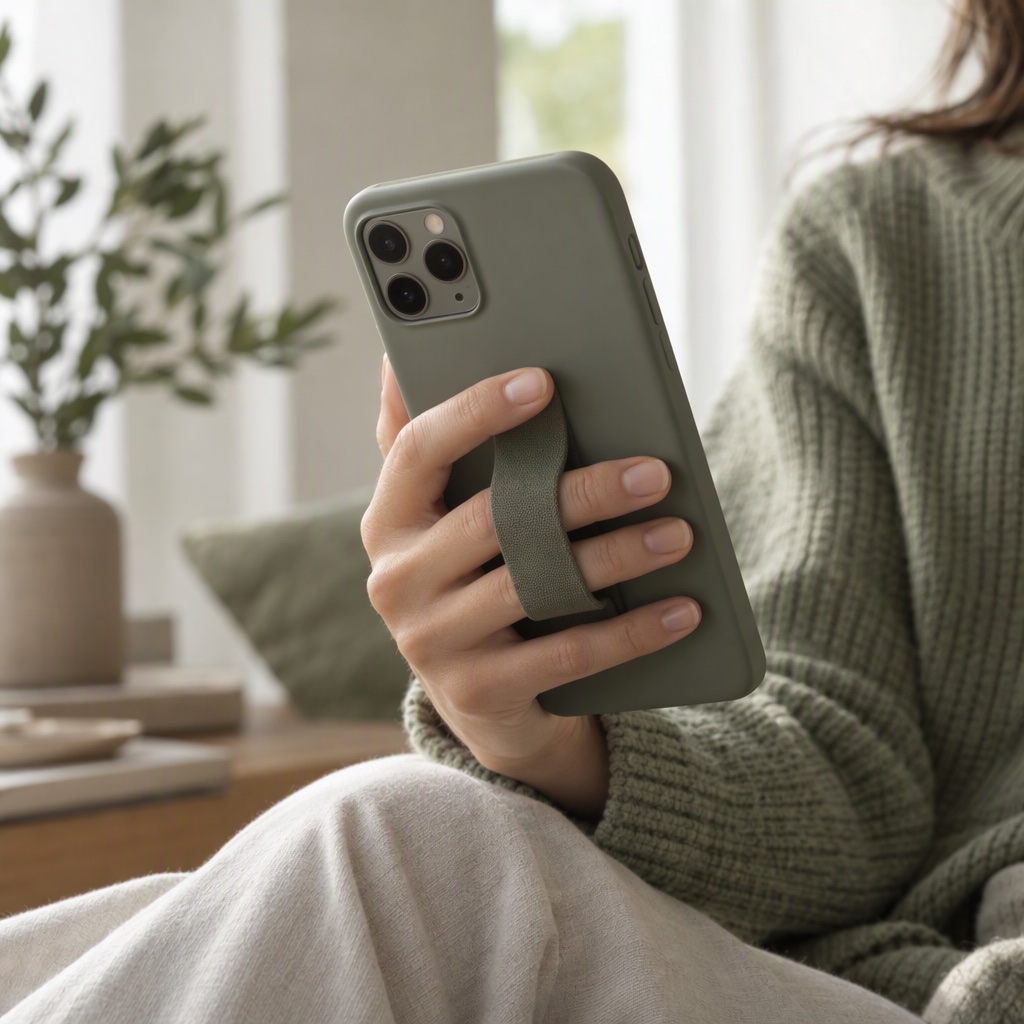
A neck strap and a wrist strap solve the same problem in opposite ways. A neck strap takes the phone off your body entirely and lets you keep your hands free, while a wrist strap keeps the phone attached to one hand and is far easier to forget you are wearing. The choice comes down to how you move: standing and walking suits a neck strap, sitting down and moving around a room suits a wrist strap. Neither is a substitute for a case, and both need a case with a proper attachment point.
- Choose a neck strap for hands-free days out and for a phone you want off your body.
- Choose a wrist strap for the home, the office and anywhere you set the phone down often.
- Neck straps are adjustable and suit heavier phones; wrist straps suit lighter ones.
- Both need a case with a real thread point or a fitted strap case.
What is each strap actually for?
A neck strap converts the phone into something you wear, hanging at chest height so it is always available and never in a pocket. It is the classic solution for festivals, markets, walks and travel days, and it also helps people who find pockets awkward or who carry a bag. A wrist strap attaches to your hand and disappears into daily life: it stops the phone sliding off a sofa, out of a pocket while you sit, or off a table when you stand up quickly. It is cheaper, lighter and easier to wear all day. The real difference is what happens when you let go: with a neck strap the phone hangs safely, and with a wrist strap it dangles from your wrist and needs you to still be holding the loop.
When is a neck strap clearly better?
When your hands are busy, when you are moving through a crowd, or when the phone would otherwise live in a bag you would rather not carry. A neck strap also helps if you use the phone frequently but briefly, such as checking a map, taking photos or following a recipe while standing. Longer adjustable straps suit taller wearers and heavier phones, while shorter ones keep the phone higher and stop it swinging. At a market or festival, a strap that sits close to the body is harder to snatch than a phone held out in front of you, which is why a strap is often the accessory people add first. The trade-off is that a phone hanging at chest height bounces when you move quickly, and it can get in the way when you bend down.
When is a wrist strap clearly better?
Around the house and at a desk, where the risk is forgetting the phone rather than wanting it permanently accessible. Wrist straps are also excellent for older children, for people who use a phone one-handed for long periods, and for anyone who regularly sets a phone down on a sofa or a café table. They are less obtrusive, easier to put on and take off, and much cheaper to replace. A loop that fits comfortably, with a swivel or rotating attachment, avoids the strap twisting into a tangle while you hold the phone. Choose a strap width that spreads the weight without being bulky, and check that the attachment is stitched and anchored properly rather than simply glued to a thin tab. Our overview of phone straps and lanyards covers the field in more depth.
How do weight, comfort and safety compare?
A heavier phone is far more comfortable on a neck strap than on a wrist strap, since a wrist loop concentrates the whole weight of the phone on one point and gets uncomfortable after a few minutes. Neck straps spread that weight across your shoulders and neck, and wide padded straps spread it further. Material matters too: a smooth webbing strap is easy to clean and does not absorb sweat, while fabric and beaded options can be heavier and are harder to dry if they get wet. Whatever you choose, check the stitching and the anchor point before you rely on it, and treat any strap as a safeguard rather than a guarantee. Adjustable straps are worth the slight extra cost, since an unadjustable strap is either too short or too long and ends up unused. A strap that fits is the one you will actually wear.
How do you attach either strap to your phone?
It depends on the case. Some cases have a built-in slot or anchor for a strap thread, which is the most secure option because the load goes into the case rather than onto adhesive. Others accept a small strap tab that fits between the phone and the case, which is convenient but slightly weaker and can move when you pull. The strongest setups use a case designed for the strap, with a reinforced anchor point. Never thread a strap through a case cut-out that was not intended for it, since the plastic will eventually tear. If you already use a grip or a ring holder, check whether it has a strap loop, which some do. Beaded and fabric phone straps often thread the same way, so you can swap between styles on the same case. If you carry the phone without a bag, our guide to carrying a phone without a bag is worth a look.
How do you decide for your own routine?
Be honest about where the phone spends the day. If it sits in a pocket while you walk, a neck strap replaces the pocket. If it sits on a table while you move around the room, a wrist strap prevents the fall. If you do both at different times, a wrist strap is usually the better first purchase because it is cheaper, lighter and useful in more situations, and a neck strap can come later for specific outings. Consider how often you take the phone in and out: a strap worn once a week has to be comfortable for that short period, while one you wear daily for eight hours needs to be gentle on your neck. Try to match the strap to the phone’s weight, and expect to adjust it a few times before it feels right. Most people end up with one of each and use them for different days.
Frequently asked questions
- Can I put a strap on any phone case? No. It needs either a built-in strap slot, a case designed to take a tab, or a grip or ring with a loop. Threading a strap through an unintended cut-out will eventually tear the case.
- Is a neck strap safe for the phone itself? A good strap is, but a swinging phone can hit door frames and table edges. Choose a length that keeps the phone close to your body, and take it off before leaning over surfaces where it could drop.
- Will a wrist strap work with a heavy phone? It will work for short periods, but the weight on one point gets uncomfortable. For a heavier phone or longer use, a neck strap or a case with a shoulder strap is more comfortable.
- Can I wash a fabric strap? Wash fabric and beaded straps gently by hand and let them dry fully before using them again. Wet straps stretch, and a damp strap against your neck or wrist is uncomfortable and can mark light clothing.
- Is a strap enough protection against theft? It makes a quick snatch harder, but it is not theft-proof. In crowded places, keep the phone close to the body rather than hanging at the back, and stay aware of your surroundings regardless of what you are carrying.


