

Card storage in a phone case is a genuine trade-off. The appeal is obvious: one less thing to carry, and a card or a transit pass always to hand. The costs are bulk, weight, a slightly thicker pocket profile, and the fact that a wallet case landed on its corner is more likely to bend a card than a separate wallet would be. Whether it is worth it depends entirely on how many cards you actually carry and how often you need them.
- Take a slim card holder or magnetic card case rather than a full wallet for one or two cards.
- Anything more than three cards stops closing properly and adds a big bulge.
- Wallet cases do not protect as well against drops as slim protective cases.
- Keep an emergency note or card accessible if you rely on the phone for payments.
What are the different ways to store cards on a phone?
There are three designs. A full wallet case has a covered pocket, usually holding two to six cards plus a note, and closes with a flap or a magnetic edge. It is the bulkiest option but the one that carries most. A slim card holder sticks or snaps onto the back of an existing case and holds one or two cards, which keeps the phone’s protective case intact. A magnetic-compatible card holder sticks to the back of a case with a built-in magnet and takes a single card, and it comes away cleanly when you want the phone bare. The right choice depends on whether you already own a protective case you like. If you do, the stick-on or magnetic options preserve it; if not, a wallet case replaces two purchases with one.
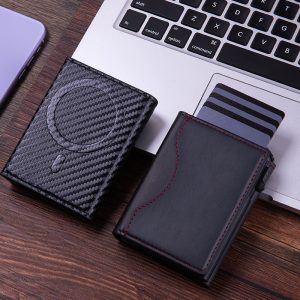
iPhone Cases — case. Designed for everyday carry and backed by our 30-day happiness guarantee.
What are the advantages of carrying cards in the case?
The main one is that you stop carrying a separate wallet for short trips, which is exactly the moment a card holder case wins. A coffee run, a dog walk, a commute or a festival stop becomes a phone-only errand. A transit pass or a door card planted in the case is available without opening anything, which is a genuine time-saver at a turnstile. Cash has somewhere to live too, which saves carrying a coin purse. If you already use a lanyard or a crossbody pouch, the whole setup becomes even simpler: cards, phone and keys and nothing else. For people who habitually lose separate wallets, consolidating into one item you always check for has a real benefit. The sections below weigh this against the costs honestly, since a card case is not a free upgrade.
What are the disadvantages?
Weight and thickness are the first two. A wallet case pushes the phone from a slim slab into something the size of a small clutch, and it no longer sits flat on a desk. That thickness is also in your pocket all day, either as a visible outline or as a bulge that catches when you sit down. Protection is the trade-off nobody mentions: a wallet case concentrates a drop’s impact into the card pocket, which is why cards bend and occasionally crack in a bad fall, and the added bulk changes how the phone tumbles. Wireless charging can be affected too, since cards and the magnets that hold them sit directly over the charging coil. Finally, having every card in one place makes the phone itself more valuable to lose, so a case with card storage deserves a screen lock at minimum.
How many cards should you realistically carry?
One or two is the sweet spot for a stick-on or magnetic holder. At that level the addition is barely noticeable and the convenience is real. Three is usually the point where a full wallet case starts making sense, because you have stopped testing the concept and simply need the capacity. More than three or four, and the case stops closing properly, the phone becomes lopsided, and the pocket bulge turns into a problem you solve by carrying a bag again. If you find yourself emptying the wallet case down to two cards, switch back to a slim holder. Cards with raised numbers or thick chip cards take more room than flat contactless ones, and older cards are sometimes slightly warped, which is worth knowing before you buy a tight pocket. Test with your actual cards rather than the ones in the product photo.
How does card storage interact with other accessories?
It changes several things at once. A wallet case usually rules out a magnetic ring holder or a stick-on grip, because the pocket occupies the back and any adhesive has to go through the card wall. Wireless charging may slow down or fail, so check your case and card combination before assuming the pad is broken. A lanyard or strap needs a thread point, and wallet cases rarely have one, which pushes you back towards a crossbody pouch instead. A screen protector with a raised lip is more important on a wallet case, since the phone is more likely to land face-down when it is a chunky object. Our comparison of a wallet case versus a phone pouch covers this choice in more detail.
Who should skip card storage entirely?
Anyone who likes a slim phone, or who relies on a phone as their main camera and wants a flat back for a grip or a tripod plate. People who already carry a small bag, and who would therefore gain nothing from consolidating, do not need it either. If you use a phone wallet with your bank’s app, you already have payments and cards available without any physical storage. Anyone who works in a bulky jacket, or who sits down and stands up all day, will feel a wallet case in the pocket far more than an occasional user. Choosing between card storage and a simple protective case is really a choice between convenience on short trips and comfort all day. There are useful notes on what belongs in a phone pouch if you decide against a wallet case.
Frequently asked questions
- Do wallet cases block wireless charging? Often, yes, if the cards sit over the coil or the case is too thick for the pad. Try charging with one card removed, and if it still fails, the case itself is the problem rather than the charger.
- Will the cards demagnetise in a phone case? The magnetic stripe on old cards can be affected by strong magnets, though most modern cards are contactless and rely on a chip. Keep a spare card somewhere else if you depend on one that might be sensitive.
- How many cards fit in a typical wallet case? Most hold between two and four comfortably, with a slot for a note or two. Stuffing more than the design allows stops the case closing and leaves a bulge that bends the cards.
- Can I use a card holder with a case I already own? Usually yes, if the case has a flat back. A stick-on holder works on most smooth cases, while a magnetic holder needs a magnetic-compatible case or a metal plate inside.
- Is a wallet case as protective as a standard case? Generally less so for drops onto corners, because the card pocket adds a weak point. If protection is your priority, keep a slim protective case and add a separate card holder rather than combining the two.


