
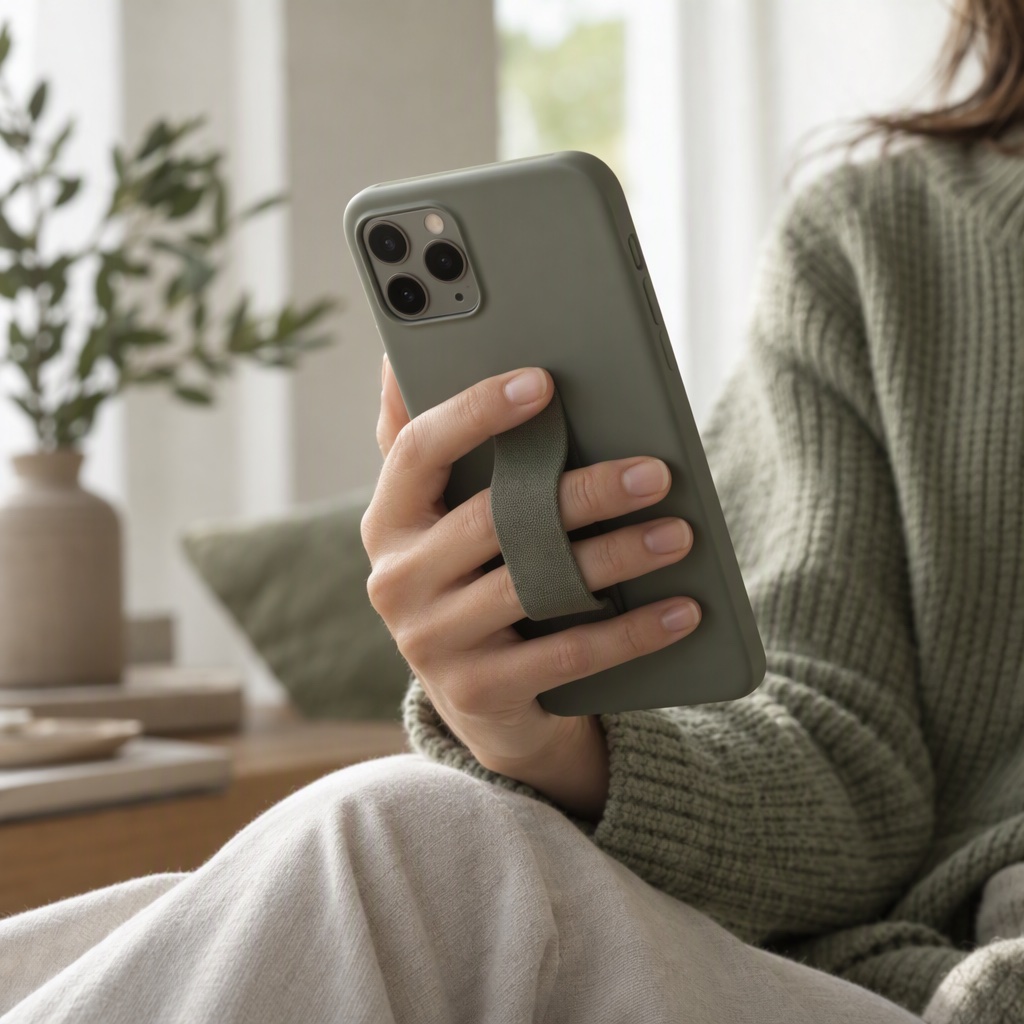
If arthritis or stiff, painful joints make a phone hard to hold, the accessory that helps most is one that takes the pinch out of gripping. Ring holders, larger U-shaped grips and stands that hold the phone for you all reduce how tightly you need to close your hand. None of this is medical advice, but choosing the right grip genuinely changes how long you can comfortably use a phone in one sitting.
- Look for grips you can slide a finger through, rather than ones you have to pinch closed.
- A ring holder lets you support the phone with one finger instead of a whole hand.
- Rotating hinges matter most, so the grip can move without you twisting your wrist.
- Stands and holders that hold the phone for you are the most comfortable option of all.
Why is gripping a phone hard on stiff or painful joints?
Holding a phone normally means closing your hand around it and pinching with the thumb to reach across the screen. Both actions compress small joints, and holding that position for minutes at a time is what causes the ache. A flat, smooth phone also needs more force to keep hold of than a textured one, so the hand works harder than necessary. The problem compounds when you hold the phone one-handed while the other hand does something else. Everything that follows comes from one idea: shift the work from your fingers to the accessory. A grip that lets one finger take the weight, or a stand that removes holding entirely, will extend how long you can comfortably read, type or watch. It is not about strengthening the hand; it is about redesigning the task.
Grips & Ring Holders — holder. Designed for everyday carry and backed by our 30-day happiness guarantee.
What grip shapes work best for limited hand movement?
A U-shaped or loop grip is usually the best starting point, because your finger slides through the loop and the phone hangs from it rather than being squeezed. That single change turns a four-finger pinch into a one-finger hang, and it is easy to take the weight of the phone on the side of the hand instead of the joints. Ring holders work on the same principle and double as a kickstand on a table, which is useful when you want a break from holding altogether. Look for a loop you can fit two fingers through if one feels unstable, and avoid narrow rigid loops that force an exact finger position. A grip on the back of the case, positioned where your little finger naturally sits, is another option worth trying. Reading our guide to whether phone grips are worth it helps with the wider choice.
How should a ring or grip be positioned for comfortable use?
Position matters as much as shape. A ring placed low on the back of the case, near the middle or the bottom third, lets the phone balance against your finger when you rotate it up to watch something. Placed too high, the phone tips forward and your thumb has to hold the weight. If you mostly type, a slightly higher position keeps the phone stable while the thumb reaches the keys. Most ring holders stick on with adhesive, so decide the position carefully before you press it down, and remember that repositioning means cleaning the residue and starting again. A case with a built-in ring or a slot for one is more secure than an adhesive pad, and it keeps the magnet and grip aligned. Test the position by holding the phone the way you actually hold it, not the way the product photo suggests.
Do hinges and rotation make a difference?
They do, and this is where many cheap grips fall short. A ring that folds flat but does not rotate means you have to turn your wrist to move between portrait and landscape, which is exactly the motion that aggravates stiff joints. A rotating hinge lets the phone change angle while your hand stays still, and a hinge with adjustable tension holds the position instead of flopping. Look for a hinge that moves smoothly rather than one that clicks into fixed stops, since fixed positions rarely match how you sit. Metal hinges hold their tension far longer than plastic ones, and a stiff hinge is easier to operate with a fingertip than a loose one. If a hinge becomes loose over time, a replacement grip is inexpensive and brings back the whole benefit.
Grips & Ring Holders — holder. Designed for everyday carry and backed by our 30-day happiness guarantee.
When is a stand better than a grip?
For anything longer than a minute or two, a stand beats a grip every time, because holding nothing is more comfortable than holding something lighter. A weighted desktop stand at the right angle turns reading, video calls and recipes into a hands-free activity, and it keeps the phone at eye height so your neck is not doing extra work. In bed or on a sofa, a gooseneck clamp that attaches to a bedside table or a headboard holds the phone exactly where you want it. In the kitchen, a stand with a non-slip base holds a recipe at a readable angle without being held. The main thing to look for is stability, since a stand that slides defeats the purpose. If you find yourself gripping the phone even when it is propped up, the angle is wrong and the stand needs adjusting.
What else helps day to day?
Larger screen text and a larger keyboard reduce how precisely you have to tap, which cuts the fine pinching that tires small joints. Voice input and voice commands remove the typing strain entirely for messages and searches, and most phones handle them well now. Keep the phone in a case with a bit of texture, because a smooth case needs a stronger grip. If the phone lives on a table, a short stand plus a wireless charging pad means it is always topped up without being picked up. Our guide to choosing a desk phone stand covers what makes a stand stable and adjustable. The common thread is to remove the hardest part of the task rather than push through it.
Frequently asked questions
- Will a grip actually reduce pain while using my phone? For many people, yes, because it changes the grip from a pinch to a hang and removes the constant thumb pressure. Results vary, so treat it as a cheap experiment rather than a fix, and stop if anything hurts.
- Should I choose a ring grip or a loop grip? A loop grip spreads the weight across one finger and suits most people. A ring grip doubles as a kickstand, so it is the better choice if you also want hands-free viewing on a table.
- Can I attach a grip to a case I already own? Usually yes, if the case has a flat panel on the back. Some cases come with a slot for a ring, which is stronger than adhesive, and magnetic-compatible cases work with magnetic ring holders.
- Does a grip interfere with wireless charging? Thick grips can, if they sit over the centre of the phone where the charging coil is. Place a ring lower on the case or choose a slim magnetic ring to keep good contact.
- Is a heavier phone easier or harder to hold comfortably? Heavier is usually harder for extended holding, though it can feel more stable for short use. A lighter case plus a grip or stand is generally the more comfortable combination.


