
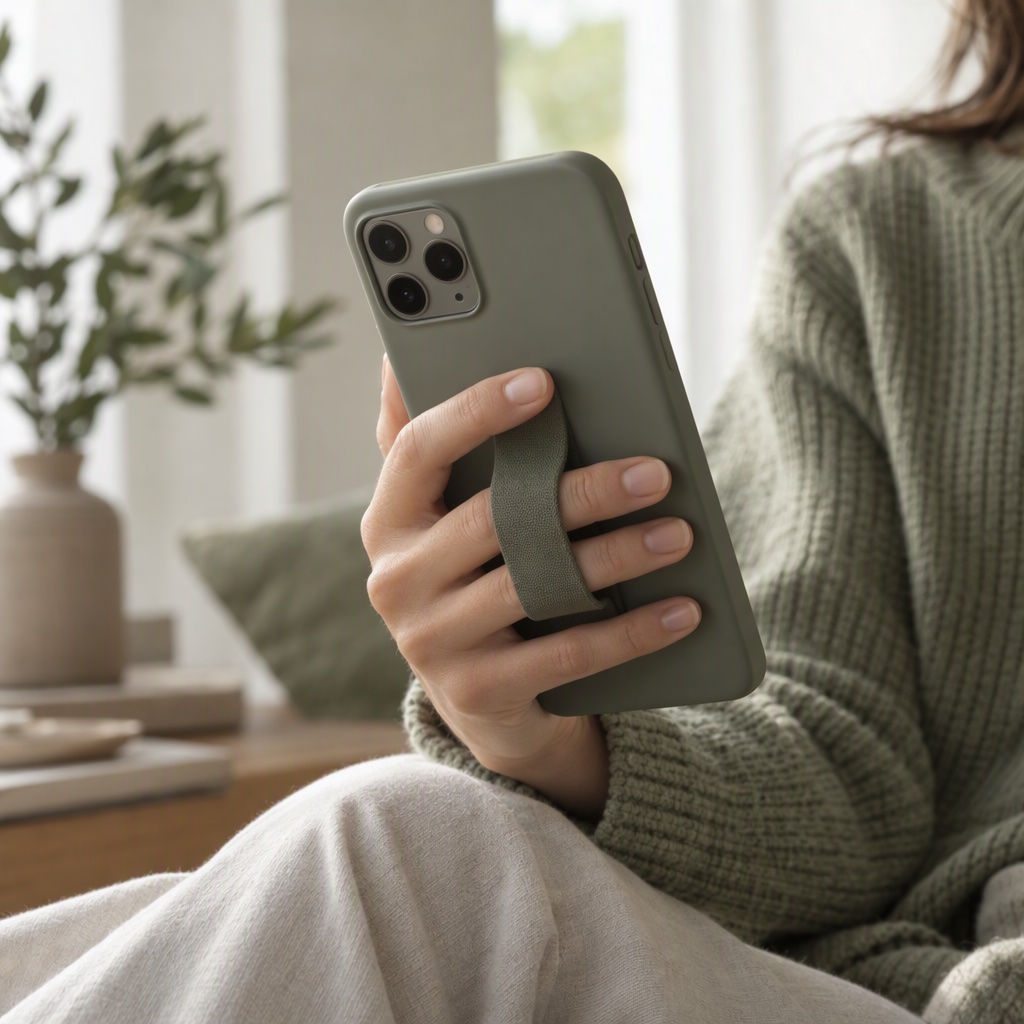
Phone grips do one useful thing: they give your fingers something to hold on to. That reduces drops on large phones and makes one-handed use workable again. Whether that is worth a few dollars depends entirely on whether you have ever fumbled a phone — and for most people the answer is yes, once, at a moment they would like to forget.
- Grips help most people with large phones, which are genuinely harder to hold one-handed.
- Two main designs: an expandable pop socket and a fixed ring or loop.
- A ring or loop stands up to day-to-day wear better than an expanding socket with moving parts.
- A grip doubles as a small stand for video calls and desk viewing.
What problem do grips actually solve?
Two real ones. First, grip: a modern phone is large and smooth, and the safest way to hold one is to slide a finger behind it, which a grip makes comfortable. Second, one-handed reach: with a grip, a finger sits near the middle of the back, so you can reach the top corner of the screen with your thumb much more comfortably. If you have never succeeded in taking a one-handed photo of the top of a tall screen, a grip fixes that immediately. If you carry a small phone, the benefit is smaller but still real. It also changes how comfortably you read in bed, because holding a large phone flat over your face strains the wrist in a way a simple finger loop does not. That reduced wrist angle matters more over a long evening of reading than most people expect, right up to the point their hand actually starts to ache.
Grips & Ring Holders — holder. Designed for everyday carry and backed by our 30-day happiness guarantee.
Pop sockets versus rings
A pop socket expands and collapses with a spring, and it folds flat when you do not need it. That fold is also its weakness — the moving parts collect pocket lint and can stick. A fixed ring, or a loop of webbing, does the same job with nothing to break, and it is almost always cheaper. The trade-off is thickness: a ring sticks out permanently, so it makes a phone slightly harder to slide into a tight pocket. Which you choose comes down to whether you mind a small bump. Our recommendation for daily use is the simplest fixed design. Geometry matters more than colour: a grip that sits near the centre of gravity keeps the phone balanced, while one placed low makes it tip forward. A grip placed too low shifts the centre of gravity and makes the whole phone tip forward whenever you set it down on an uneven surface.
Do grips interfere with wireless charging?
Sometimes, yes, if the centre of the phone is covered by a magnetic or metallic base. A slim plastic ring rarely causes problems, and a magnetic grip certainly can. If you use a wireless charging puck, hold the phone against it and check for a charge indicator before relying on it. The typical failure is the phone charging very slowly, which people notice but rarely diagnose. Moving the grip slightly higher or lower on the back usually fixes it. Test it properly by placing the phone on the charger and watching the indicator for a full minute rather than glancing at it, because slow charging shows up that way. Watch the indicator for a full minute rather than glancing at it, because a slow trickle of charge is easy to miss on a quick look.
Are grips useful as stands?
More than people expect. Collapse a pop socket part-way and a phone propped against it stands at a reading angle, which is ideal for following a recipe or a video call. A ring does the same in one position. For desk viewing, a proper stand is steadier and adjustable; for watching at a casual angle, the grip is more convenient. If you already have a grip, try it as a stand before buying a dedicated one. For watching video, an angle of around sixty degrees from horizontal works well, and anything steeper simply sends the phone sliding flat on its face. An angle of around sixty degrees from horizontal works well for watching video, and anything steeper sends the phone sliding flat onto its face.
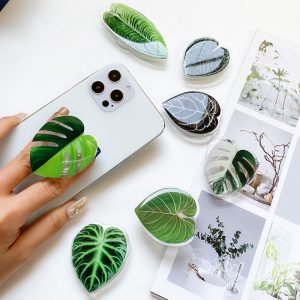
Grips & Ring Holders in Green. Designed for everyday carry and backed by our 30-day happiness guarantee.
Will a grip hold up on a case?
Most grips attach to a case rather than the phone, and a good case has a recessed smooth area for it. Adhesive grips peel off thin, flexible, or textured cases sooner than rigid ones. A ring that threads through the case is far more durable than an adhesive one. Check the adhesive rating too — 3M-style adhesives hold for years, but they do not survive repeated soaking. If you swim or kayak with a phone, prefer a threaded design. If you change cases regularly, a threaded loop is reusable and can be moved between cases, which makes it far cheaper over years than the adhesive kind. A threaded loop can be moved between cases, which makes it dramatically cheaper over a couple of years than replacing an adhesive grip each time.
Does a grip protect against drops?
A grip cannot protect a phone that is more than a metre above a hard floor — drops from pocket height still crack screens. What it does is reduce the chance of a drop happening in the first place, which matters over years of use. The real drop protection is the case, and a case with raised corners and a lip around the camera. Read more about the case side in choosing a phone case that actually protects and our comparison of rugged versus slim cases. Consider where you actually use your phone, because stairs, busy platforms and wet surfaces are where the drops really happen. Stairs, station platforms and wet surfaces are where the drops really happen, and those are exactly the moments a grip is designed to survive.
Frequently asked questions
- Do grips work with a wallet case?Adhesive grips often stick to soft leather poorly. Choose a case with a smooth flat panel or use a threaded loop.
- Can I move a grip to a new case?Adhesive grips are single-use, because the adhesive cannot be reattached as strongly. A threaded loop can move.
- Are magnetic grips better than rings?Magnetic grips unlock faster for car mounts but are heavier and can slow wireless charging.
- How thick does a grip make a phone?A ring is roughly the thickness of a coin. A collapsed pop socket is similar. Both are noticeable in a tight pocket.
- What is the cheapest useful option?A simple webbing finger loop. It has no moving parts and does the main job better than a fancy one.
A soft fabric loop also gives away nothing to the eye and never snags a pocket lining, which matters if you slide the phone into tight clothing.


