
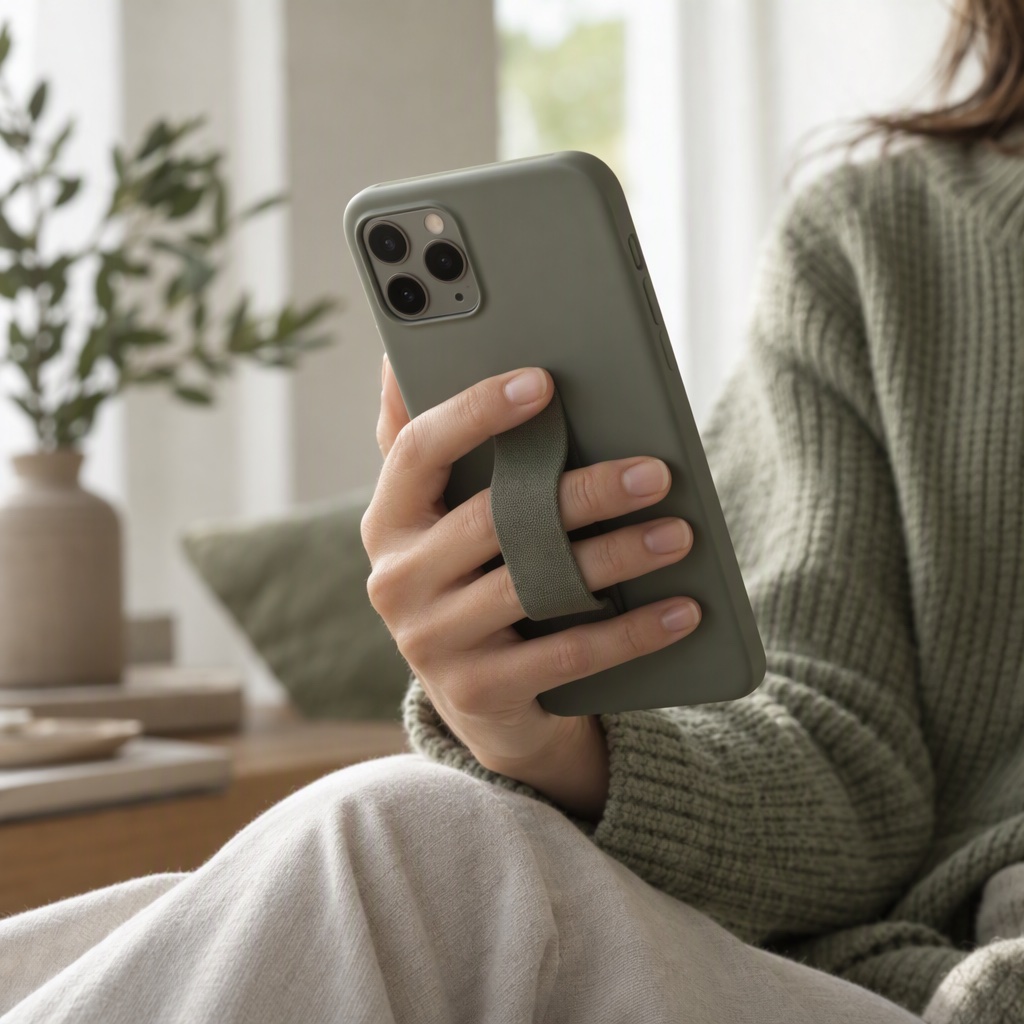
A floating phone strap is a lanyard or wrist strap built with buoyant material, so that if you drop the phone into water the strap keeps the whole assembly at the surface instead of letting it sink. It is not a waterproof case and it does not make your phone water-resistant — it is a recovery aid. The strap floats; the phone dangles just below it. For anyone who spends time near open water, on a paddleboard, in a kayak, or on a dock, that small difference is the one that turns a lost phone into a wet phone you can still grab. It works best when the phone is also protected and light enough for the strap to hold up.
- A floating strap keeps the phone at the surface after a drop — it is a recovery aid, not a waterproof case.
- Buoyancy comes from foam or a sealed air chamber inside the strap body, not from the cord itself.
- It works best when the phone is in a light case, since a heavy phone can drag the strap under.
- Attach it to a case you trust, test it in shallow water first, and rinse it with fresh water after salt exposure.
What is a floating phone strap, exactly?
It is a strap with buoyant material built into it — usually a short, thick section of closed-cell foam or a sealed air chamber wrapped in fabric — that you wear on your wrist or around your neck. The strap attaches to the phone or its case, and because the buoyant part sits at the top, the phone hangs a short distance below the surface when it goes in. The purpose is recovery, not protection. Nothing about a floating strap keeps water out of the phone’s ports, and the phone will still be submerged. What changes is that it will be floating at arm’s reach rather than sinking out of sight, which is the difference between a bad afternoon and a replacement purchase. It is a simple idea that solves one specific, expensive problem.
What makes a strap float?
Buoyancy comes from displacing more water than the object weighs, so a floating strap needs trapped air or very low-density material. Most designs use closed-cell foam, which does not absorb water and keeps working after repeated dunkings, or a small sealed air pocket stitched inside the strap body. The cord itself is usually not buoyant — a thin woven cord sinks. That is why cheap floating straps often fail: the buoyant section is too small for the weight of a modern phone, so the strap stays at the surface while the phone drags it under. Look for a visibly thick, padded section rather than a slim cord with a small foam bead. If the buoyant part is barely bigger than your thumb, it will struggle with a large phone.
How does a floating strap attach to a phone?
Almost all of them attach to a case rather than the phone itself, because phones rarely have a lanyard point. There are two common systems. The first is a short cord that threads through a lanyard hole in the case, which is secure and simple if your case has one. The second is an adapter that fits between the phone and the case, or a plate that slides into the charging port, with the strap attached to that. The port-based versions are convenient but sit in the one opening you most want to keep clean, so they suit a phone that is not being charged while it is near water. Whichever system you use, check the attachment weekly — a strap is only as good as the point it hangs from.
When is a floating strap genuinely useful?
It earns its place in any situation where a drop means deep water rather than a floor. Paddleboarding, kayaking, and canoeing are the obvious ones, because a phone over the side is usually gone for good. Docks, piers, and jetties are another, since a phone that slips while you are tying up is often out of reach immediately. Fishing from a bank or a boat, swimming from a pontoon, and working around a pool all qualify too. It is less useful in shallow, clear water where you can simply reach down, and it is pointless on land, where a normal wrist strap or lanyard does everything you need at a fraction of the bulk. Buy one for the water, not as an everyday accessory.
What are the limits of a floating strap?
It is worth being honest about what it cannot do. A floating strap does not keep water out of the phone, so a submerged phone still needs drying and should not be charged until you are certain the port is dry. It does not guarantee recovery in moving water — a current can carry a floating phone out of reach faster than you can react. A heavy phone in a thick case may overwhelm the buoyancy, especially if the case traps a pocket of water. And the strap can snag on branches, rocks, or boat fittings, which is a genuine safety consideration on moving water. Treat it as one layer of a plan that also includes a pouch, a dry bag, and a habit of not holding the phone over open water.
How do you choose and look after one?
Choose the buoyant section by size first — bigger is more effective — and pick a length that keeps the phone close to your hand rather than swinging near your knees. A wrist loop is safer than a neck strap on moving water, since anything around the neck can catch. Test the strap in shallow water with the phone inside a case you do not mind getting wet, so you know exactly how it behaves before it matters. After every trip in salt water, rinse the strap in fresh water and let it dry fully in the shade, because salt left in the foam and fabric degrades it over a season. Check the cord and the attachment point for fraying before each use. For everyday carrying, see phone straps and lanyards: do you need one? and how to protect your phone at the beach.
Frequently asked questions
- Does a floating strap make my phone waterproof? No. It keeps the phone at the surface so you can recover it. Water still reaches the phone, so dry it thoroughly and wait before charging.
- Will it float a phone in a thick case? Sometimes not. Buoyancy has a limit, and a heavy phone in a bulky case can drag the strap under. Test yours in shallow water first.
- Can I use one on a wrist instead of around my neck? Yes, and a wrist loop is generally the safer choice on moving water, since nothing is around your neck to catch on anything.
- How do I clean a floating strap? Rinse it in fresh water after every use in salt water, then let it air dry in the shade. Avoid machine washing, which can crush the foam.
- Is a floating strap worth it if I only swim in a pool? Usually not. In shallow, clear water you can simply reach down. It pays off where a drop means deep or moving water.


